Practical Advice For Making Good Decisions


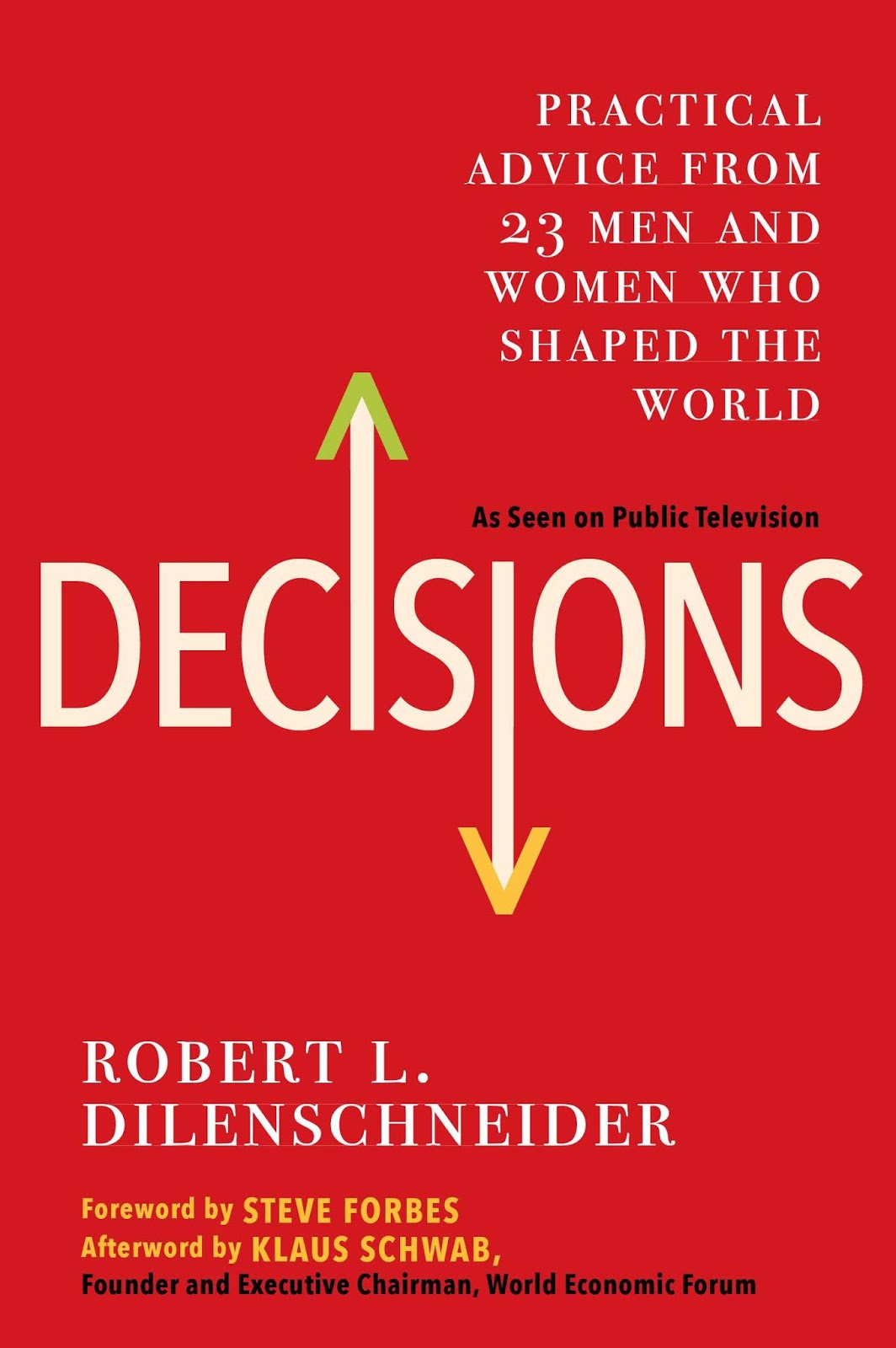
Late last year brought the new book, DecisionsAs seen on Public Television, the book by Robert L. Dilenschneider, features vignettes on 23 individuals who made decisions that shaped the world.

Each chapter offers practical thinking on how these women and men made decisions. You can use their decision-making skills as guidance at work, in your leadership role, and in your daily life.

You’ll learn decision making tips from Harry TrumanMargaret ThatcherMohammed AliRachel CarsonPablo Picasso and others who made decisions during war and peace, and in fields of science, commerce and invention.

Author Dilenschneider suggests takeaways about decision-making from each featured historical figure. Some of my favorite decision-making lessons from history and from the book include these: 
  • Own your decisions. Be responsible for them and for their implications. Do not be reactionary—that is, making decisions to spite others or because of outside pressure—but do be respectful of their effect on others.
  •  Keep your decisions in perspective. Many are vital, many are not. Even so, try to take all of them seriously.
  •  Be aware of how your decisions will affect others, either directly or by the example they set.
  •  It is essential to have your own “code,” made up of your life experience, your education, your conscience, and all the other building blocks of character. Often this is called having a “moral compass.”
  •  Have a group of trusted advisors already at hand – family, friends, colleagues – and do not be afraid to reach beyond that close circle to bring in experts as appropriate. Consult these people! Always gauge their motivation. And then test their advice against your judgement.
  •  It doesn’t matter if you don’t always hit the exact bull’s eye. The other rings in the target score points too.
  •  Know everything you can about the needs and desires of the people who will be affected by your decisions or who will need to carry out your decisions.
  •  When possible use stories and illustrations to make your point about your decision.
  •  You will not be able to foresee all or even many of the results of your decisions. As those results become apparent, and external/internal conditions change, be prepared to make new decisions.
  •  When your decision plays out to a positive result, be humble.

Comments

Popular posts from this blog

Three Essential Parts Of A Mission Statement

A lot of companies struggle when creating their mission statement. Author  Peter F. Drucker  provides the following good advice in one of my favorite book's of his,  The Five Most Important Questions You Will Ever Ask About Your Organization : Every mission statement has to reflect three things : Opportunities Competence Commitment In other words, he explains: What is our purpose? Why do we do what we do? What, in the end, do we want to be remembered for? How well does your mission statement meet Drucker's recommended three requirements?

10 Quotes From The 5 Levels Of Leadership -- John C. Maxwell

Soon I'll post my full review of John C. Maxwell's latest book, The 5 Levels of Leadership .  In the meantime, here are some of my favorites quotes from the book that I believe should become a must-read book by any workplace/organizational leader: Good leadership isn't about advancing yourself.  It's about advancing your team. Leaders become great, not because of their power, but because of their ability to empower others. Leadership is action, not position. When people feel liked, cared for, included, valued, and trusted, they begin to work together with their leader and each other. If you have integrity with people, you develop trust.  The more trust you develop, the stronger the relationship becomes.  In times of difficulty, relationships are a shelter.  In times of opportunity, they are a launching pad. Good leaders must embrace both care and candor. People buy into the leader, then the vision. Bringing out the best in a person is often a catal...

The Science Of Dream Teams

Why do some teams succeed while others stumble? Because hiring, developing and engaging talent requires careful decisions that are too easy to get wrong without data. In The Science of Dream Teams: How Talent Optimization Can Drive Engagement, Productivity, and Happiness , author Mike Zani introduces the science of “ talent optimization ,” a new discipline that’s a far more reliable way to manage your employees than your gut instincts.  “ Proper talent optimization lifts morale, builds teams, and turbocharges productivity ,” explains Zani.  With simple steps, Zani (a former US Olympic sailing team coach) shows how companies of any size can collect and analyze voluntary data about their employees to purposefully align a company’s business and talent strategies.  The book explores how CEOs and management teams can collect and use data to: Build effective teams of highly sought-after professionals while optimizing costs. Create a company culture based on coaching versus ...

How to Be a Leader – 9 Principles from Dale Carnegie

Today, I welcome thought-leader Nathan Magnuson as guest blogger... Nathan writes : This is it, your first day in a formal leadership role.   You’ve worked hard as an individual contributor at one or possibly several organizations.   Now management has finally seen fit to promote you into a position as one of their own: a supervisor.   You don’t care if your new team is only one person or ten, you’re just excited that now – finally – you will be in charge! Unfortunately the euphoria is short-lived.   Almost immediately, you are not only overwhelmed with the responsibilities of a team, but you quickly find that your team members are not as experienced or adroit as you.   Some aren’t even as committed.   You find yourself having to repeat yourself, send their work back for corrections, and staying late to fill the gap.   If something doesn’t change soon, you might just run yourself into the ground.   How did something that looked so easy ...

How To Join The Mission Generation

Whether you're a first-time job seeker, midlife pivoter, or legacy-minded leader, you're probably asking: Does my work matter? What am I really building? How can I keep contributing?   Fortunately, there is a new book that will help you learn how to build clarity as you go—clarity about what kind of work feels worth doing and how to align your time, energy, and effort accordingly.   This book is In The Mission Generation: Rewrite Success, Reclaim Your Purpose, Rebuild Our Future , written by venture capitalist, Stanford University lecturer, and CEO of the NobleReach Foundation Arun Gupta and strategic management expert and business professor Thomas J. Fewer, PhD .   “The Mission Generation isn't defined by age―it's bound by conviction. This book offers a new blueprint for every age and stage, one that doesn't force you to choose between making money and finding meaning,” explain the authors.   They also share the future of work isn’t about choosing between ...

How To Predict And Prevent Conflict At Work And At Home

T he book, How To Get Along With Anyone , by John Eliot and Jim Guinn , is the playbook for predicting and preventing conflict at work and at home.  As you read the book, you will discover how to defuse any heated conflict by learning which of the five conflict styles you are and how to resolve even the most sensitive dispute with this must-read guide.  Through decades of building and facilitating team chemistry for Fortune 500 companies, professional sports franchises, schools and government agencies, nonprofit organizations, and families, Eliot and Guinn have discovered people respond to conflict in one of these five ways:  Avoider : Uninterested in minor details; excels in solitary work with a knack for concentration.  Competitor : Always pushing the envelope; never rests on laurel and takes risks for achievement.  Analyzer : Evidence-based and methodical; patiently gathers information before acting.  Collaborator : A deeply caring individual, relying o...

How To Lead With Deep Purpose

Having conducted extensive field research, Ranjay Gulati , author of the book, Deep Purpose , The Heart and Soul of High-Performance Companies , reveals the fatal mistakes leaders unwittingly make when attempting to implement a reason for being.   “My interviews with well over 200 executives across 18 firms revealed the secrets of these companies—not the usual facile frameworks, but new ways of thinking about business that allow leaders and companies to operate with heightened passion, urgency, and clarity,” shares Gulati. “I call this, deep purpose .”   Furthermore, Gulati explains that most leaders think of purpose functionally or instrumentally, regarding it as a tool they can wield. On the other hand, deep purpose leaders think of it as something more fundamental; an existential statement that expresses the firm’s very reason for being. These leaders project it faithfully out onto the world.   “Rethinking the nature of purpose should prompt you in turn to re-imagine ...

How To Give Praise To An Employee

Years ago, Entrepreneur magazine offered these timeless and valuable tips on how to give praise : Praise followed by criticism is not praise. Praise followed by praise is probably a little too much praise. Ending an expression of praise with "...and stuff" nullifies the praise. And, Make it timely. The closer the recognition is to the behavior, the more likely the behavior will be repeated. Be sincere. Be impromptu.  Remember, a handwritten note is worth more than a gift card. Having trouble writing your handwritten note of praise? Try this template to get you started : _______, I couldn't be more impressed with how you______.  Not only did you____, but also you_______.  Beautiful. Thanks, ________

How To Become More Courageous

“Fear creates the gap between who you are and who you can be. Courage closes it,” explains Margie Warrell, PhD , author of the book, The Courage Gap: 5 Steps To Braver Action .  “To clarify, closing your courage gap is not about 'de-risking' your life or sheltering from problems—natural and human created. Rather, it is about bringing the bravest version of yourself to every situation,” adds Dr. Warrell.  That includes actively taking on rough problems, doing what is unpopular, facing storms head-on, and maybe even reshaping the broader landscape in the process. Dr. Warrell empowers us to recognize that courage is a learnable skill accessible to everyone, regardless of how risk-averse, timid, or defensive we may be.  Additionally, for leaders , The Courage Gap provides a guide to operationalize and scale the courage mindset across your team and organization to deepen trust, dismantle silos, foster innovation, accelerate learning, and unleash collective courage toward a ...

How To Make Smarter Decisions In The Age Of AI

  Artificial Intelligence (AI)  promises to improve worker productivity  with the potential to automate activities accounting for a  large share of our workday . Organizations are increasingly relying on AI technology for everything from simple, everyday tasks to complex decision-making.    “Yet, most of us are using AI ineffectively, allowing it to lead us rather than the other way around,” says Cheryl Strauss Einhorn , author of the new book, The Human Edge: Smarter Decisions In The Age Of AI .   The book is an essential, empowering, and timely guide for professionals, leaders, and teams who want to make better, more confident choices when using AI systems. It offers practical tools to help frame problems and surface solutions, using AI to augment—not replace—your judgment.     More specifically, Einhorn provides a step-by-step guide for AI-supported decision-making techniques, such as:    Breadth to Depth:  Knowing when and ...