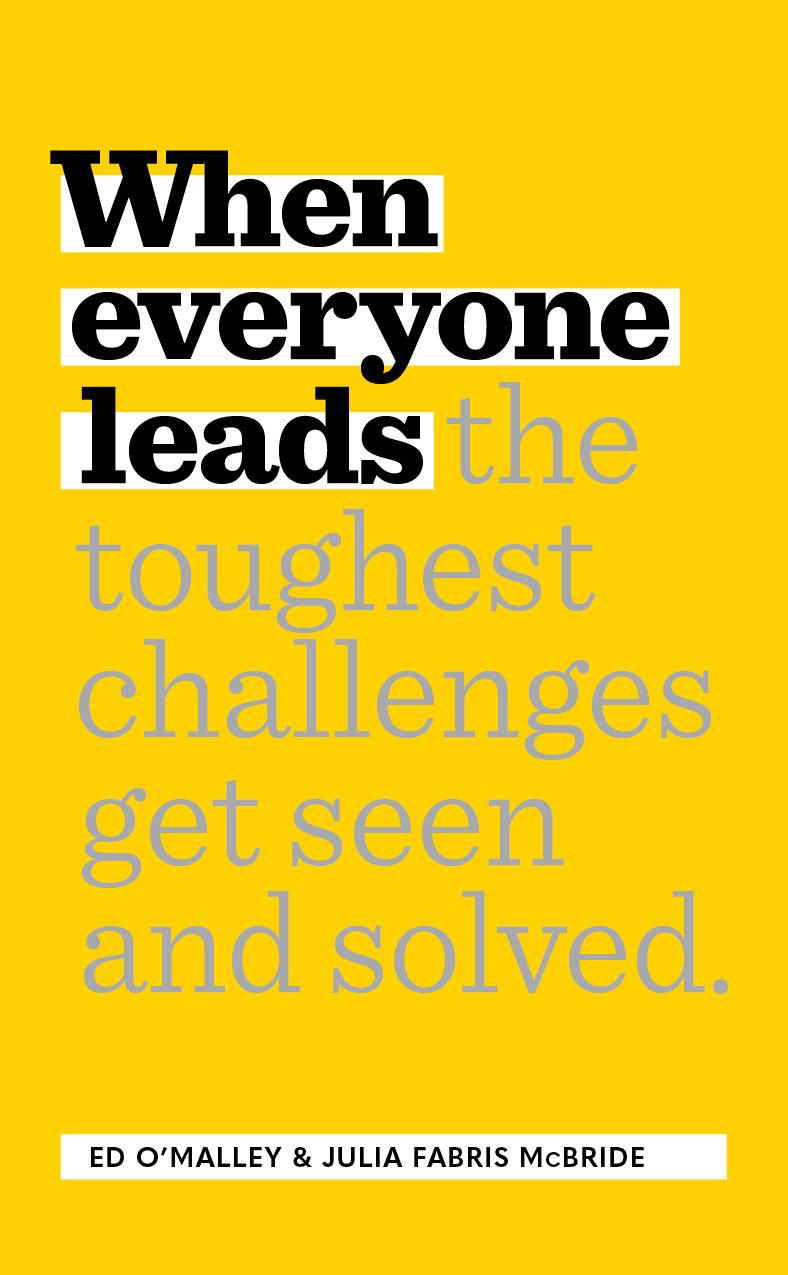
The Benefits Of When Everyone Leads


It’s only January and the new book, When Everyone Leads, could likely be my pick for the best new leadership book of 2023. It’s that good. There’s still nearly a whole year ahead of us so we’ll see what other books debut. In the meantime, add this book to your must-read list. 

You’ll learn that:

  • Leadership is an activity, not a position.
  • Leadership is mobilizing others to make progress on the most important challenges.
  • Leadership is interactive, risky and experimental.
  • Leadership comes in moments.
  • Leadership is always about change. 

When Everyone Leads, by Ed O’Malley and Julia Fabris McBride, presents a revolutionary approach to leadership; not based on position or authority, but an activity that anybody can undertake by learning to spot opportunities for improvement and taking the initiative to engage others. 

“It can be unfamiliar and uncomfortable, but in a culture where everyone leads, organizations start to make progress on their most difficult problems,” explain the authors. 

As founder and chief leadership development officer at the Kansas Leadership Center, respectively, O’Malley and Fabris McBride have led thousands of people through programs to help them engage in the act of leadership. They have seen remarkable results with people from all walks of life, but they’re also keenly aware of the obstacles that tend to come up. In When Everyone Leads, they delve into: 

  • Identifying the Gap: how to pinpoint the area where your organization needs to improve, the gap between where you are and where you want to be;
  • Overcoming Barriers to Progress: how to circumvent common pitfalls that impede growth, including value clashes within a team and resistance to changing the status quo;
  • Starting With You: how to empower yourself to take the first steps towards leadership;
  • Using the Heat: getting your team to the productive zone between avoidance of the tough challenges (heat too low) and clashes over how to solve them (heat too high);
  • Inviting Everyone to Lead: specific steps to take, questions to ask, and methods of thinking that you can use to engage in the act of leadership, and allow your peers to do the same. 

Full of specific examples of challenges and solutions from fields as diverse as nonprofits, school boards, healthcare, and the corporate world, When Everyone Leads, offers a proven, actionable approach for any company, organization, or community to navigate through its most pressing challenges. 

The book is fast paced and highly readable, with a bold design including graphics, end-of-chapter Q&A’s, and bite-size content presentation for easy reading and comprehension. You’ll discover what you learn from the book is relatable and directly applicable.

Julia Fabris McBride and Ed O'Malley

Today, the authors share these insights with us: 

Question: Why did you decide to write the book? 

The Authors: Our hope in writing this book is to build on a movement we’ve already started. A movement that inspires more people to practice leadership where they can and when they can. We want to spread our counterculture leadership ideas far beyond the people we can reach through our in-person and Zoom-base programs. Because our world needs more people to embrace the ideas in this book and to step up and start leading. 

The new model leadership we talk about in When Everyone Leads is a match for our turbulent times. It is hopeful and forward-looking. We know through our experience working with hundreds of companies, organizations, and communities that what you’ll discover in our book is an antidote for polarization, stagnation, and divisiveness. Our model works because it places the challenge, not the person, at the center. 

It's pretty counterculture of us to declare, as we do in the book, that even if you are the CEO (or the governor, prime minister, or president) with today’s toughest challenges, your authority alone will never be enough to bridge the gap between where you are and where you want to be. Another way to put that is no matter who we elect (or appoint, or hire) their brilliance will never be enough to solve our most pressing problems. Progress on what matters most requires those in authority to do their part, but their part alone is insufficient. 

Leadership position and leadership team are outdated terms from a model that no longer works. Think eliminating poverty, stopping climate change, achieving racial equity, or building the innovative organizational culture your company needs to survive. Authority is not enough to solve those daunting challenges. (Don’t get us wrong. Our institutions need structure and processes, and people in authority positions to keep it all running. Society would fall apart without that. Authority is necessary. It’s just not sufficient.) 

We need everyone ­to have understand that leadership is an activity. It is not a role. It’s a thing we do. We need everyone to know that leadership is mobilizing others to make progress on complex and entrenched challenges, and that each of us has a responsibility to find our moments to lead. 

That’s why we wrote this book.

Question: Tell us more about your reader-engaging approach in book presentation -- combination of Q&As, letters, illustrations, conversational style. 

The Authors: If we want everyone to lead, we needed a book that everyone would want to read. 

We love that you think it’s engaging in its presentation. That’s exactly what we were going for. When Everyone Leads is as much for avid readers as it is for people who read just one book a year. It’s a business book that is accessible to non-businesspeople. It’s a quick read that a busy executive can digest in an evening. It’s for the activist who doesn’t have time to read. It’s for visual learners who almost never read. The design – by Stauber Design Studio – is intended to draw you in and pull you along quickly. The short chapters with a semi-predictable rhythm to them make it easy to dip in and out. 

We want teams and groups to read and discuss this book together and we know from experience with Ed’s first book that Pat Byrnes’ cartoons are great conversation starters. He draws for the New Yorker, so that gives you an idea of the kind of compelling images we were going for.   

Our bullet-pointed lists of tips and traps make it easy to begin applying the ideas in the book right away. That’s our big goal. Get as many people as possible to pick up the book, thumb through and think, “This book is for me.” 

Question: How has the Kansas Leadership Center influenced your book? 

The Authors: We launched the Kansas Leadership Center (KLC) in 2007 with funding from a foundation whose board members understood that the quality and quantity of leadership is key to the prosperity, health, and success of organizations, companies, and communities. Over the last 15 years worked with over 15,000 people using the ideas in this book. Our research and experience with partners throughout our state and around the world, show that the ideas in this book work to help people make more progress on what they care about most. 

Question: What's your book's most important takeaway for readers? 

The Authors: We want readers to know that leadership is not about position or authority. It’s not about having the top job or the ability to command huge audiences. 

Leadership is engaging others to solve daunting challenges and achieve big aspirations. And leadership is for everyone. That’s a powerful and energizing idea: Anyone can lead, anytime anywhere. We all face challenges in our professional lives, in our communities, in our personal lives and in our families. They can seem insolvable, beyond our ability to even see what needs to be done. But they are not. 

Because leadership is an activity. It’s small actions taken in moments of opportunity. Once you’ve read our book, you’ll be able to see more of those moments. The blinders will come off and the barriers will start to fall away. You’ll see more moments and you’ll be able to seize the opportunity in those moments. And, most importantly, you can help others see those opportunities too. 

Today’s toughest challenges demand a new approach to leadership. 

Thank you to the book’s publisher for sending me an advance copy of the book.

Comments

Popular posts from this blog

10 Quotes From The 5 Levels Of Leadership -- John C. Maxwell

Soon I'll post my full review of John C. Maxwell's latest book, The 5 Levels of Leadership .  In the meantime, here are some of my favorites quotes from the book that I believe should become a must-read book by any workplace/organizational leader: Good leadership isn't about advancing yourself.  It's about advancing your team. Leaders become great, not because of their power, but because of their ability to empower others. Leadership is action, not position. When people feel liked, cared for, included, valued, and trusted, they begin to work together with their leader and each other. If you have integrity with people, you develop trust.  The more trust you develop, the stronger the relationship becomes.  In times of difficulty, relationships are a shelter.  In times of opportunity, they are a launching pad. Good leaders must embrace both care and candor. People buy into the leader, then the vision. Bringing out the best in a person is often a catal...

The Psychology Of Leadership

I read many books about leadership and this book is one of my favorites. It’s  The Psychology of Leadership  by  Sebastien Page . It offers a fresh take on leadership through the lens of groundbreaking research in positive, sports, and personality psychology.  “Like exercise strengthens your body, practicing positive, sports, and personality psychology will make you a better leader,” says Page.  The book blends research, fascinating true stories, humor, and self-improvement advice to deliver simple yet powerful principles to master the mental game of leadership.  Page reveals timeless strategies for achieving lasting impact, fostering growth, and promoting well-being. He demonstrates how leaders and individuals can balance measurable goals with practical approaches to maximize performance and fulfillment.  “Effective leadership is not merely about achieving measurable outcomes. It requires aligning goals with intrinsic motivations and psychological ins...

How to Be a Leader – 9 Principles from Dale Carnegie

Today, I welcome thought-leader Nathan Magnuson as guest blogger... Nathan writes : This is it, your first day in a formal leadership role.   You’ve worked hard as an individual contributor at one or possibly several organizations.   Now management has finally seen fit to promote you into a position as one of their own: a supervisor.   You don’t care if your new team is only one person or ten, you’re just excited that now – finally – you will be in charge! Unfortunately the euphoria is short-lived.   Almost immediately, you are not only overwhelmed with the responsibilities of a team, but you quickly find that your team members are not as experienced or adroit as you.   Some aren’t even as committed.   You find yourself having to repeat yourself, send their work back for corrections, and staying late to fill the gap.   If something doesn’t change soon, you might just run yourself into the ground.   How did something that looked so easy ...

The Many Times You Should Thank Customers

In your leadership role, it's vital that your team members know how to deliver excellent customer service. " Knock Your Socks Off " type service as book editor  Ann Thomas  and  Jill Applegate  would say. Part of delivering excellent customer service is saying "Thank You" to your customers and knowing when to say "Thank You". Thomas and Applegate recommend  telling your customers "Thank You" during at least these nine situations : When they do business with you...every time. When they compliment you (or your company) When they offer you comments or suggestions When they try one of your new products or services When they recommend you to a friend When they are patient...and even when they are not so patient When they help you to serve them better When they complain to you When they make you smile You and your team members can say "Thank You" : Verbally In writing  (and don't underestimate the power of  perso...

How To Uncover Your Blindspots To Become A More Effective Leader

What you don't see about yourself can hold you back as a leader. That's typical for many leaders. What we don't see is what we  can't  see: we have  blindspots . Your blindspots prevent you from achieving your greatest success.  “It turns out that we're often not great judges of ourselves, even when we think we are. Sometimes we're simply unaware of a behavior or trait that's causing problems,” explains  Martin Dubin , author of the book,  Blindspotting: How To See What’s Holding You Back As A Leader . “Bottom line: until we uncover these blindspots, we can't move forward. The good news is that you can learn to do your own  blindspotting .”   “Most of us understand the idea of blindspots in a general sense—areas we can’t see, to take the term most literally, or places we have gaps that we may not even realize, to be a little more abstract,” says Dubin.  “But in the context of this book, I’m defining blindspots quite specifically: They are the...

70 New Year's Resolutions For Leaders

  With 2026 fast approaching, it's a good time to identify your New Year's Resolutions for next year. To get you started, how about selecting one or more of the following 70 New Year's resolutions for leaders? Perhaps write down five to ten and then between now and January 1, think about which couple you want to work on during 2026. Don't micromanage Don't be a bottleneck Focus on outcomes, not minutiae Build trust with your colleagues before a crisis comes Assess your company's strengths and weaknesses at all times Conduct annual risk reviews Be courageous, quick and fair Talk more about values more than rules Reward how a performance is achieved and not only the performance Constantly challenge your team to do better Celebrate your employees' successes, not your own Err on the side of taking action Communicate clearly and often Be visible Eliminate the cause of a mistake View every problem as an opportunity to grow Summarize group consensus after each deci...

Leadership Lessons From A Serial Entrepreneur

Brad Jacobs’ new book provides you a treasure trove of leadership lessons from a man with more than four decades of CEO and serial entrepreneur experience. So, even if you don’t envision yourself wanting to earn a billion dollars, don’t pass up reading Jacob’s, How To Make A Few Billion Dollars .   In the book, Jacobs defines the mindset that drives his remarkable success in corporate America  –  and distills a lifetime of business brilliance into a tactical road map. And he shares his techniques for:   Turning a healthy fear of failure to your advantage. Building an outrageously talented team. Catalyzing electric meetings. Transforming a company into a superorganism that beats the competition.   “This book is about what I’ve learned from my blunders, and how you can replicate our successes,” says Jacobs. He shares his candid account of the highs and lows of entrepreneurship.  Jacobs has founded seven billion-dollar or multibillion-dollar businesse...

How To Harness The Power Of Experiential Intelligence

“Experiential Intelligence provides a new lens from which to view what makes you, you—and what makes your team and organization unique,” says  Soren Kaplan , author of the book,  Experiential Intelligence . Kaplan explains that over 100 years ago, we established IQ (Intelligence Quotient) to predict success. Then we explored Emotional Intelligence (EQ), the theory of multiple intelligences, and mindsets that broaden the definition of smarts.   “Today,  Experiential Intelligence  ( XQ ) expands our understanding of what's needed to thrive in a disruptive world. While you can't change the past, your unique experiences and stories contain hidden strengths and untapped potential for the future,” explains Kaplan.   Experiential Intelligence is the combination of mindsets, abilities, and know-how  gained from your unique life experiences that empowers you to achieve your goals. It allows you to get in touch with the accumulated wisdom and talents you have ga...

70 New Year's Resolutions For Leaders

With 2024 fast approaching, it's a good time to identify your New Year's Resolutions for next year. To get you started, how about selecting one or more of these 70 New Year's resolutions for leaders? Perhaps write down five to ten and then between now and January 1, think about which couple you want to work on during 2024. Don't micromanage Don't be a bottleneck Focus on outcomes, not minutiae Build trust with your colleagues before a crisis comes Assess your company's strengths and weaknesses at all times Conduct annual risk reviews Be courageous, quick and fair Talk more about values more than rules Reward how a performance is achieved and not only the performance Constantly challenge your team to do better Celebrate your employees' successes, not your own Err on the side of taking action Communicate clearly and often Be visible Eliminate the cause of a mistake View every problem as an opportunity to grow Summarize group consensus after each decision point...

8 Tips For Leaders New To Blogging

Here are eight tips for leaders new to blogging or for leaders who want to ensure their company's Blog is the most effective it can be: Use keywords for your business in your Blog posting headlines. Write about the pain points of your target reader. Be sure your Blog covers topics where you or your company is truly an expert. Keep your Blog postings short.  Keep paragraphs and sentences short.  Use bullets. Include a call to action.  Perhaps you ask a question or offer a downloadable white paper.  Or, ask readers to sign up for your company's e-newsletter. Publish a list that is likely to be shared by your Blog's readers.  Include and quote industry experts in your Blog postings. Use free metrics and analytical tools to measure which of your postings are best read and shared.  Use the tool to track the sources that drive the most traffic to your Blog.