How Compassionate Leaders Deliver Results

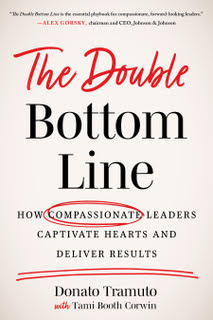
“Putting people first and delivering results are not two separate goals,” according to the book, The Double Bottom Line. “Rather, a strong focus on people drives strong results, creating the double bottom line,” adds author Donato Tramuto (with Tami Booth Corwin).

Tramuto's findings are based on decades of experience, numerous studies, original qualitative research of 1,500 participants, and in-depth interviews with nearly 40 successful leaders who practice compassionate leadership. 

“Research reveals that most leaders have an innate desire to be compassionate, but many don’t know how to put it into practice,” adds Tramuto.

The Double Bottom Line defines compassionate leadership as: 

Listening to others’ challenges, needs, or problems, having empathy for them and then actually doing something about it. 

Additionally, where empathy is the ability to think about and feel for another person’s problems, suffering, or experience. And, where compassion, on the other hand, usually starts with or coexists with empathy, but it adds the desire and action to relieve that person’s suffering, help them overcome a challenge, or otherwise better their situation. 

  • Tramuto says that compassionate leadership is driven by a desire and a commitment to better your people, your customers, your stakeholders, and your community. It’s about understanding what touches the hearts of others in order to bring out the best in them and allow them to feel connected to their work and see it as a part of something bigger than themselves. 

However, “practicing compassionate leadership effectively does not mean ignoring or setting aside the tough issues,” explains Tramuto. “It doesn’t mean that you let people off the hook if they need constructive feedback. It doesn’t mean that people who don’t perform or who do something to damage your culture, or your company shouldn’t be held accountable.” 

“Now more than ever, leaders need to upgrade skills, such as communication, transparency, adaptability, and understanding and support of employee’s needs,” shares Tramuto. “I challenge leaders to see compassion in a different light, as a strength, a critical skill, and as an imperative.” 

In the book, Tramuto explains how leaders can be strong, firm, and tough while sticking to their values and principles. It makes the case that compassion is power. 

Finally, one of my favorite takeaways from the book is where Tramuto explains how great leaders are great listeners, and where he clarifies the differences between hearinglistening and understanding

  • Hearing is the simple perceiving of sound. It doesn’t’ take any action on the part of the person hearing. It is passive. 
  • Listening involves action. Listening is hearing something with thoughtful attention. A good listener is involved in conversation with committed participation. It involves a conversation. 
  • Understanding requires thoughtful attention with some empathy and inquiry added. To understand, you must ask relevant questions and build as complete and accurate a picture as possible through reconfirmation of information shared. It is active and interactive. 

Thank you to the book’s publisher for sending me an advance copy of the book.

Comments

Popular posts from this blog

Resolve To Find A Mentor In 2026

Having a mentor is one of the best things you can do to advance your career as a leader. So, decide soon to secure a mentor who will work with you during 2026. Make that one of your New Year’s resolutions. A mentor can benefit leaders new to their leadership role, and they can benefit experienced and seasoned leaders, as well. A strong mentoring relationship allows the mentor and the mentee to develop new skills and talents, to build confidence, and to build self-awareness. Proper mentoring takes a commitment from both parties, and it takes time to develop and to reap the rewards of the relationship. Plan to work with your mentor for no less than three months, and ideally for six months or longer. When seeking out a mentor, think about these questions : 1.  Will the relationship have good personal chemistry? 2.  Can this person guide me, particularly in the areas where I am weakest? 3.  Will this person take a genuine interest in me? 4.  Does this person have the tra...

The Playbook For How To Get Along With Anyone

T he book,  How To Get Along With Anyone , by  John Eliot  and  Jim Guinn , is the playbook for predicting and preventing conflict at work and at home.  As you read the book, you will discover how to defuse any heated conflict by learning which of the five conflict styles you are and how to resolve even the most sensitive dispute with this must-read guide.  Through decades of building and facilitating team chemistry for Fortune 500 companies, professional sports franchises, schools and government agencies, nonprofit organizations, and families, Eliot and Guinn have discovered people respond to conflict in one of these five ways:  Avoider : Uninterested in minor details; excels in solitary work with a knack for concentration.  Competitor : Always pushing the envelope; never rests on laurel and takes risks for achievement.  Analyzer : Evidence-based and methodical; patiently gathers information before acting.  Collaborator : A deeply carin...

70 New Year's Resolutions For Leaders

  With 2026 fast approaching, it's a good time to identify your New Year's Resolutions for next year. To get you started, how about selecting one or more of the following 70 New Year's resolutions for leaders? Perhaps write down five to ten and then between now and January 1, think about which couple you want to work on during 2026. Don't micromanage Don't be a bottleneck Focus on outcomes, not minutiae Build trust with your colleagues before a crisis comes Assess your company's strengths and weaknesses at all times Conduct annual risk reviews Be courageous, quick and fair Talk more about values more than rules Reward how a performance is achieved and not only the performance Constantly challenge your team to do better Celebrate your employees' successes, not your own Err on the side of taking action Communicate clearly and often Be visible Eliminate the cause of a mistake View every problem as an opportunity to grow Summarize group consensus after each deci...

10 Quotes From The 5 Levels Of Leadership -- John C. Maxwell

Soon I'll post my full review of John C. Maxwell's latest book, The 5 Levels of Leadership .  In the meantime, here are some of my favorites quotes from the book that I believe should become a must-read book by any workplace/organizational leader: Good leadership isn't about advancing yourself.  It's about advancing your team. Leaders become great, not because of their power, but because of their ability to empower others. Leadership is action, not position. When people feel liked, cared for, included, valued, and trusted, they begin to work together with their leader and each other. If you have integrity with people, you develop trust.  The more trust you develop, the stronger the relationship becomes.  In times of difficulty, relationships are a shelter.  In times of opportunity, they are a launching pad. Good leaders must embrace both care and candor. People buy into the leader, then the vision. Bringing out the best in a person is often a catal...

How to Be a Leader – 9 Principles from Dale Carnegie

Today, I welcome thought-leader Nathan Magnuson as guest blogger... Nathan writes : This is it, your first day in a formal leadership role.   You’ve worked hard as an individual contributor at one or possibly several organizations.   Now management has finally seen fit to promote you into a position as one of their own: a supervisor.   You don’t care if your new team is only one person or ten, you’re just excited that now – finally – you will be in charge! Unfortunately the euphoria is short-lived.   Almost immediately, you are not only overwhelmed with the responsibilities of a team, but you quickly find that your team members are not as experienced or adroit as you.   Some aren’t even as committed.   You find yourself having to repeat yourself, send their work back for corrections, and staying late to fill the gap.   If something doesn’t change soon, you might just run yourself into the ground.   How did something that looked so easy ...

Best New Leadership Book Of 2025

Each year, after reviewing dozens of books about leadership, management, business and life skills, I select my pick for the best new leadership book of the year. During 2025, I reviewed on this blog 48 books, and I choose  Radical Listening: The Art Of True Connection  as the best new leadership book of 2025. To be an excellent leader you need to be an exceptional listener. Sadly, too many business leaders don't listen well or don't listen to a broad enough range of their employees. This great book will help leaders become better listeners  –  radical listeners. “For leaders, radical listening must start at the top of an organization,” state the authors  Prof. Christian Van Nieuwerburgh (PhD)  and  Dr.   Robert Biswas-Diener .    “Unless there is a clear and sustained commitment to radical listening from leaders, others are less likely to be fully engaged with the idea. This is, of course, easier said than done.”  “Most leaders woul...

The Psychology Of Leadership

I read many books about leadership and this book is one of my favorites. It’s  The Psychology of Leadership  by  Sebastien Page . It offers a fresh take on leadership through the lens of groundbreaking research in positive, sports, and personality psychology.  “Like exercise strengthens your body, practicing positive, sports, and personality psychology will make you a better leader,” says Page.  The book blends research, fascinating true stories, humor, and self-improvement advice to deliver simple yet powerful principles to master the mental game of leadership.  Page reveals timeless strategies for achieving lasting impact, fostering growth, and promoting well-being. He demonstrates how leaders and individuals can balance measurable goals with practical approaches to maximize performance and fulfillment.  “Effective leadership is not merely about achieving measurable outcomes. It requires aligning goals with intrinsic motivations and psychological ins...

Effective Listening: Do's And Don'ts

Here are some great tips from Michelle Tillis Lederman's book, The 11 Laws of Likability .  They are all about: what to do and what not to do to be a leader who's an effective listener : Do : Maintain eye contact Limit your talking Focus on the speaker Ask questions Manage your emotions Listen with your eyes and ears Listen for ideas and opportunities Remain open to the conversation Confirm understanding, paraphrase Give nonverbal messages that you are listening (nod, smile) Ignore distractions Don't : Interrupt Show signs of impatience Judge or argue mentally Multitask during a conversation Project your ideas Think about what to say next Have expectations or preconceived ideas Become defensive or assume you are being attacked Use condescending, aggressive, or closed body language Listen with biases or closed to new ideas Jump to conclusions or finish someone's sentences

Listen To Others, Especially Before You Speak

Here is a great message from the book, Stronger: Develop the Resilience You Need to Succeed : Listen to Others, Especially Before You Speak When we think of people who possess extraordinary interpersonal skill, we find they are good listeners. In even the briefest of encounters, they can make you feel important. According to author Denise Restauri, charismatic people are good listeners who make the conversation about the other person. they show genuine interest. They let the world revolve around the other person. They remember the other person's name-- and they use it. So, when you listen to people, truly listen. Look at the other person with interest. Do not multitask.

The Book Of Mistakes

Skip Prichard’s new book, The Book of Mistakes , provides a motivating and inspiring fable and journey to finding the secrets to creating a successful future. This 175-page self-help tale, wrapped in fiction, teaches you the nine mistakes that prevent many from achieving their goals . Full of wisdom, this is a book for everyone, and particularly valuable to anyone who wants to be a better leader. I won’t reveal the nine mistakes, however, here are some of my favorite takeaways and snippets from the lessons the book teaches: Be the hero of your story, not a minor character in someone else’s. Know your inherent value. Surround yourself with the people who will help you achieve your purpose. The journey to success requires both risk and failure. Look at everyone your meet as a wise teacher. Be motivated, not intimidated, by another’s success. Successful people have a sense of urgency. Prichard has featured, interviewed, and studied over one thousand of the wor...