How To Predict And Prevent Conflict At Work And At Home

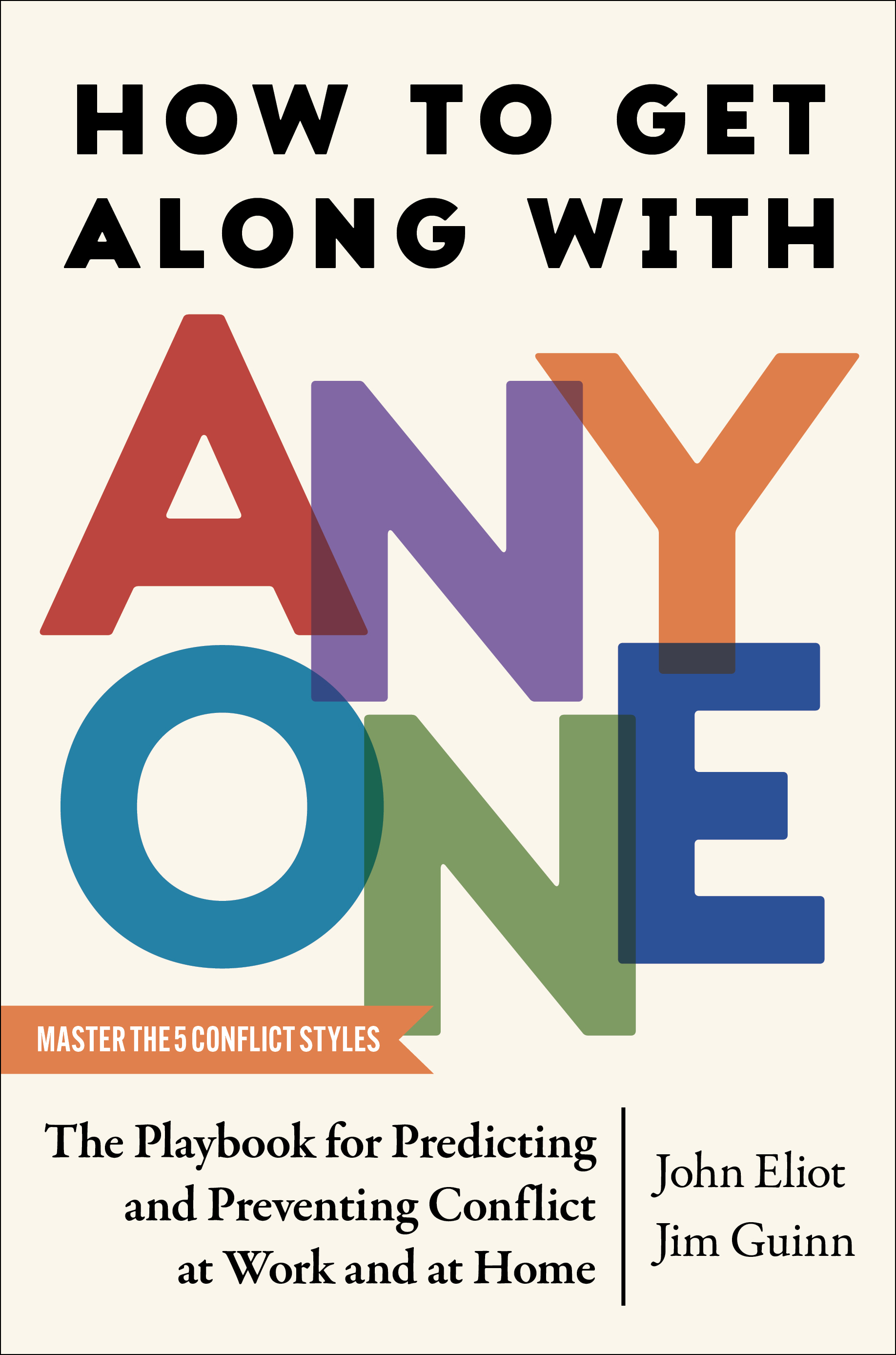
The book, How To Get Along With Anyone, by John Eliot and Jim Guinn, is the playbook for predicting and preventing conflict at work and at home. 

As you read the book, you will discover how to defuse any heated conflict by learning which of the five conflict styles you are and how to resolve even the most sensitive dispute with this must-read guide. 

Through decades of building and facilitating team chemistry for Fortune 500 companies, professional sports franchises, schools and government agencies, nonprofit organizations, and families, Eliot and Guinn have discovered people respond to conflict in one of these five ways: 

  1. Avoider: Uninterested in minor details; excels in solitary work with a knack for concentration. 
  2. Competitor: Always pushing the envelope; never rests on laurel and takes risks for achievement. 
  3. Analyzer: Evidence-based and methodical; patiently gathers information before acting. 
  4. Collaborator: A deeply caring individual, relying on exceptional relationship skills. 
  5. Accommodator: Prioritizes achievements and well-being of those they care about over their own.

“We offer you a pragmatic, hands-on guide to help you determine your own conflict style and identify your coworkers’ and loved ones’ styles. Using this information helps you to foster better communication and more effective collaboration,” the authors add. 

“If you can predict how someone will behave, you can formulate a winning game plan.”  

Why is this so important? Because the average American worker spends 156 hours a year engaged in the kind of moderate to intense workplace conflict that adversely impacts both performance and health. 

And managers spend 26% of their time addressing and resolving conflicts on their team—the equivalent of chewing up one full workday each week. 

"If conflict is left unresolved, workplace conflict leads to shifts in employee attitudes, behaviors, and interactions that spawn ripple effects to the culture and decreased motivation. Productivity declines and so does job satisfaction. Commitment wanes and morale suffers. Absenteeism increases, eventually leading to higher turnover," share the authors.

One of my favorite parts of the book is the section on active listening. The authors remind us that communication exchanges are comprised of three elements, distributed as follows: 

  • 7% - Verbal – What is said, the words themselves. 
  • 38% - Vocal – How something is said, a speaker’s projection, resonance, and tone. 
  • 55% - Visual – The way it’s said, a speaker’s facial expression and body language. 

You can become a better active listener when you do the following according to the authors: 

Be present; Be Centered. When you want to hear someone, full-and want them to know they are being heard—you need to be all in. Temporarily suspend any other concern you have beyond the goal of simply listening. 

Make Eye Contact. When the other person is talking, look them in the eyes. That is the surefire way to establish that you are attending to them. 

Stay Off The Stage. Spend the time entirely centered on what (and how) the other person is sharing. Fight the urge to weave in your opinion, view and so on. 

Be Patient. Wait For It. Remind yourself that there will be ebb and flow; there will be natural pauses. Don’t fill those pauses. Wait. Invite the other person to continue. Employ encouraging body language. Nod, Smile. 

Use Volley Phrases. When waiting for someone to continue doesn’t work, exercise volley phrases, such as, “Tell me more,” “Tell me more about,” “Run that by me again,” Please, go on.” 

Use Reflexive Questioning. This is when you feed someone’s words—and often, more importantly, feelings—back to them, in the form of a question, regarding topics on which you want to move past positions and interests. Make sure to ask these types of questions in a respectful tone, authentically showing that you care. 

Use Open-Ended Questions. And use open-ended probing by using cues that necessitate elaboration. 

Empathize. Put yourself in their footwear. With positive regard. Unconditionally. Use your active listening to decipher where a person is coming from and why. Be accepting. 

Filled with fun, engaging examples and actionable techniques, How to Get Along With Anyone teaches you how to predict and prevent escalated conflict, arming you with practical tools for flipping the script on sticking points to nurture stronger and more meaningful relationships. 

___

John Eliot, PhD, mentors executives and advises professional sports teams, coaches and athletes on how to apply individual and organizational psychology principles for enhancing health, performance, and workplace culture. 

Jim Guinn, EdD, is an assistant professor at Texas A&M University, and director of the Global Youth Sport For Development Initiative, and the Center For Sports Management Research and Education. 

Thank you to the book’s publisher for sending me an advance copy of the book.

Comments

Popular posts from this blog

How To Rewire Your Mind To Build Your Adaptability Quotient

    Alec Litowitz argues that the most valuable skill of the next decade isn't IQ or even EQ (Emotional Intelligence). It's AQ: your Adaptability Quotient, the ability to question assumptions, update beliefs, and respond effectively when reality changes.   Litowitz is the author of the forthcoming book (releasing on September 15, 2026)  The Adaptability Quotient: Rewiring Your Mind For Success In The Next Human Era .   And he shares that “AQ is a learnable way of using your mind like a high-performance machine: to model risk, absorb feedback, make faster corrections, and create repeatable advantages in conditions where most people stall out—or drown.”   In short, it’s all about how to move from “making the right decision” to “making decisions right.”   “As artificial intelligence, media, and scientific advances reshape the cognitive landscape, adaptability becomes the essential discipline for reclaiming human agency,” adds Litowitz. “And a s AI resha...

Leadership Quotes From John C. Maxwell's Book, Everyone Communicates Few Connect

The real gems in John C. Maxwell's book,  Everyone Communicates Few Connect , are the abundant leadership and communication quotes, such as these: To add value to others, one must first value others. People may hear your words, but they feel your attitude. All good communicators get to the point before their listeners start asking, "What's the point?" The first time you say something, it's heard. The second time, it's recognized, and the third time it's learned. In the end, people are persuaded not by what we say, but by what they understand. People pay attention when something that is said connects with something they greatly desire. Maxwell also says that: Management is about persuading people to do things they do not want to do, while leadership is about inspiring people to do things they never thought they could . The book covers five principles and five practices to help readers so they can connect one-on-one, in a group, o...

Learn The Power Of Probabilistic Thinking

Dive in for a fascinating read as you discover the life-changing power of probabilistic thinking, taught by Kyle Austin Young in his book, Success Is A Numbers Game .   “Every goal that you’re pursuing has two hidden numbers attached to it—a probability of success and a probability of failure,” explains Young, “If you can make the first number bigger and the second number smaller, you can rewrite your predicted outcome.”   “Whether you’re trying to start a business, run a marathon, get a promotion, earn a pilot’s license, grow a bumper crop of tomatoes, or sign an acting deal, these two percentages are always lurking in the shadows predicting what is going to happen.”   But, adds Young, "Most of us never think about them. We assume our odds are unknowable and unchangeable. This dangerous lie leads millions of people to fail at goals where they were perfectly capable of succeeding. You can choose a smarter path,” encourages Young.   In Success is a Numbers Game , ...

How To Overcome Four Common Challenges To Become A Better Communicator

“Raising your game as a communicator is one of the best ways to make a difference in the world, but it takes courage to open up to others and invite others to open up to you” says Michelle D. Gladieux , author of the new book, Communicate With Courage: Taking Risks To Overcome The Four Hidden Challenges .   Gladieux explains that those four hidden challenges and sneaky obstacles that can keep you from becoming the best communicator you can be are:  Hiding —Fear of exposing your supposed weaknesses. Defining —Putting too much stock into assumptions and being quick to judge. Rationalizing —Using “being realistic” to shield yourself from taking chances, engaging in conflict, or doing other scary but potentially rewarding actions. Settling —Stopping at “good enough” instead of aiming for something better in your interactions.  According to Gladieux, these challenges all have something in common. They require taking risks—to reveal yourself, question your beliefs,...

Lessons From CEOs On How To Start Well And Perform Quickly As The New CEO

“Walk past any airport bookstore and you’ll find countless books about what it means to be a leader or a CEO, or how to nail your first 90 days as a general executive,” says author Ty Wiggins . “What you won’t find is a book that specifically covers the challenge you face now: the CEO transition  – a period that covers your first 6–12 months in the role , which is often the most challenging and crucial time for a company and its new leader.”  Fortunately, Wiggins’ new book, The New CEO , fills that educational gap by teaching you the 10 components that make for a successful CEO transition  –    whether you are a newly announced or newly appointed CEO.   These 10 components inform the chapters within the book. “While the ideas are presented linearly, the reality is that some clearly overlap, and others may resolve only to return again,” explains Wiggins.   The 10 components are: Approaches… Getting The Message Right Act Discerningly M...

Effective Listening: Do's And Don'ts

Here are some great tips from Michelle Tillis Lederman's book, The 11 Laws of Likability .  They are all about: what to do and what not to do to be a leader who's an effective listener : Do : Maintain eye contact Limit your talking Focus on the speaker Ask questions Manage your emotions Listen with your eyes and ears Listen for ideas and opportunities Remain open to the conversation Confirm understanding, paraphrase Give nonverbal messages that you are listening (nod, smile) Ignore distractions Don't : Interrupt Show signs of impatience Judge or argue mentally Multitask during a conversation Project your ideas Think about what to say next Have expectations or preconceived ideas Become defensive or assume you are being attacked Use condescending, aggressive, or closed body language Listen with biases or closed to new ideas Jump to conclusions or finish someone's sentences

The Five Critical Roles You Need To Build A Winning Team

  The new book, Team Players , by leadership expert and New York Times bestselling author, Mark Murphy , explains why a team needs more than strong leaders—it needs the right mix of five roles and talents to succeed.   In addition, Murphy reveals that the secret to extraordinary teams isn’t making everyone the same—it’s embracing and leveraging fundamental differences through those five distinct team roles. No amount of teambuilding, trust, or cohesion can overcome having the wrong mix of people in the room.   The five essential roles and talents are:   The Director assumes a leadership role within the team, guiding its direction and making important, difficult, and even unpopular decisions.   The Achiever immerses themselves in the details of accomplishing tasks and getting things done, with a keen eye for delivering error-free work.   The Stabilizer keeps the team on track with meticulous planning, processes and procedures, clear timelines, and organi...

Daily Intentions For Leaders

Everyone can benefit from the book, Dear Friend , which features bite-sized, daily notes for contemplation, inspiration, connection, and clarity. Busy and stressed business leaders can particularly benefit from the 365 profound, heartfelt reflections from author Michelle Maros , founder of Peaceful Mind Peaceful Life and cohost of the podcast, Life Happens with Barb and Michelle .   Dear Friend invites readers to go deep and use the notes as a daily practice that compounds over time, nurturing strength, resilience, and clarity.   In just a few minutes each day, this book will offer you a daily reprieve when you feel burned out, beaten down, or overwhelmed by the strains and stresses of modern life.   The heart of Dear Friend began in the quiet mornings Michelle shared with her mom, Barb. Every day, they would sit together, reading affirmations or passages from Barb’s beloved books. These small rituals—simple but powerful—set the tone for each day, grounding them in g...

Book Review: The Elephant In The Room

Diana McLain Smith's new book, The Elephant in the Room , explains how relationships make or break the success of leaders and organizations. It's not a light right.  For those who really want to understand relationships, however, this book, based on Smith's clinical research and a wealth of in-depth observational studies, is both insightful and worth the effort. Smith explains that when people click or clash, we typically chalk it up to chemistry and leave it at that.  But, she knows there are many dynamics within that relationship that need understanding by a leader to create success. In fact, she says it's possible to identify and analyze the seemingly mysterious ingredients that go into the makings of a relationship.  And, given the right tools, it's possible to understand what happens when a relationship forms, and then to actually anticipate what might happen next .  That anticipation is critical, claims Smith. Smith also shows read...

How To Be A Serial Winner

The Cycle of Winning has five parts:  Decide, Overdo, Adjust, Finish, Keep Improving . These are the five actions that winners take to get on track and to help stay on tract. Theses actions create Serial Winners, explains  Larry Weidel  in his book,  Serial Winner . "Serial Winners leverage a cycle of winning action to make progress," says Weidel. "They do something every day that puts them on a course for the things they want in life." "As you read [the book], you'll realize that you're already doing some of these things. But one or more of them will jump out at you -- the things you're missing," adds Weidel. In the book, Weidel presents a step-by-step process that you can apply to your  life, career and in your business . Larry Weidel For example, Weidel teaches: Don't Hesitate, Decide  -- Serial Winners make up their minds to being and then they keep moving. They know the clock is ticking and they need to continually ma...