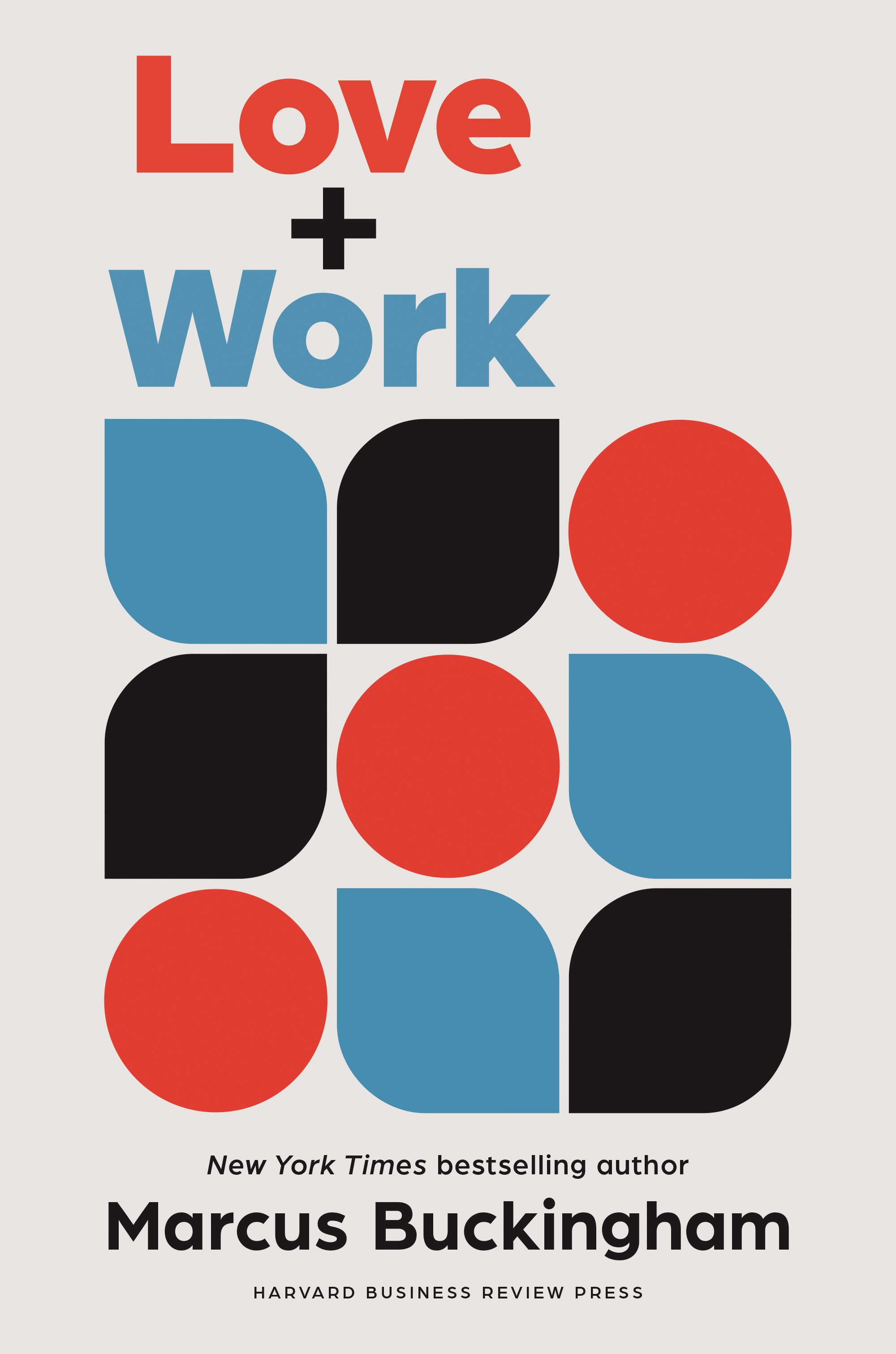
How To Find What You Love And Love What You Do

Do you have a chance to play to your strengths every day?

Were you excited to go to work every day last week? 

How you answer these two questions will determine if you are more likely to be successful, resilient, and engaged at work – and likely to do something great in your life by taking seriously what you love and expressing it in some sort of productive way. 

This is what bestselling author, Marcus Buckingham, explains in his book, Love + Work

“You've long been told to ‘Do what you love,’ shares Buckingham. “Sounds simple, but the real challenge is how to do this in a world not set up to help you. Most of us actually don't know the real truth of what we love—what engages us and makes us thrive—and our workplaces, jobs, schools, even our parents, are focused instead on making us conform. Sadly, no person or system is dedicated to discovering the crucial intersection between what you love to do and how you contribute it to others,” declares Buckingham. 

Therefore, the need for Buckingham’s new book. A book that guides readers on how to center love in their lives and fend off common pitfalls tempting them off their path. 

In this highly personable, conversational, insightful, eye-opening, empowering and uplifting book, he shows you how to decode your own loves, turn them into their most powerful expression, and do the same for those you lead and those you love. 

More specifically, he teaches you how to:

  • Use love to reveal your unique gifts.
  • Pinpoint what makes you stand out from anyone else.
  • Choose the right role on the team.
  • Describe yourself compellingly in job interviews.
  • Mold your existing role so that it calls upon the very best of you.
  • Position yourself as a leader in such a way that your followers quickly come to trust in you.
  • Make lasting change for your team, your company, your family, or your students. 

To help identify your loves, Buckingham recommends you:

Pay attention to what you pay attention to. And, realize that you have some things that you instinctively yearn to do—before you’ve even tried them, and you find your hand going up and your mind leaning in. These instincts are the first sign of love, and, they have wisdom within them. 

Furthermore, he suggests you answer these love-seeking questions:

When was the last time…

  • You lost track of time?
  • You instinctively volunteered for something?
  • Someone had to tear you away from what you were doing?
  • You felt completely in control of what you were doing?
  • You surprised yourself by how well you did?
  • You were singled out for praise?
  • You were the only person to notice something?
  • You found yourself actively looking forward to work?
  • You came up with a new way of doing things?
  • You wanted the activity to never end? 

“In all my research, it has been crushingly obvious that the most successful people found roles that a) fulfilled their sense of purpose – they believed in the ‘why’ or the role, b) allied them with colleagues they trusted and admired—they connected to the ‘who’ of the role, and c) contained activities they loved—they enjoyed the role’s ‘what,’” shares Buckingham. 

Love + Work provides you a roadmap for infusing love back into your work—and, on a broader scale, in your life.

Marcus Buckingham

I’ve always been a big fan of Buckingham’s work and his latest book further solidifies my commitment to learning from him. 

Thank you to the book’s publisher for sending me an advance copy of the book.

Comments

Popular posts from this blog

10 Quotes From The 5 Levels Of Leadership -- John C. Maxwell

Soon I'll post my full review of John C. Maxwell's latest book, The 5 Levels of Leadership .  In the meantime, here are some of my favorites quotes from the book that I believe should become a must-read book by any workplace/organizational leader: Good leadership isn't about advancing yourself.  It's about advancing your team. Leaders become great, not because of their power, but because of their ability to empower others. Leadership is action, not position. When people feel liked, cared for, included, valued, and trusted, they begin to work together with their leader and each other. If you have integrity with people, you develop trust.  The more trust you develop, the stronger the relationship becomes.  In times of difficulty, relationships are a shelter.  In times of opportunity, they are a launching pad. Good leaders must embrace both care and candor. People buy into the leader, then the vision. Bringing out the best in a person is often a catal...

How To Play Bigger And Be A Category King In Business

"The most exciting companies create. They give us new ways of living, thinking, or doing business, many times solving a problem we didn't know we had -- or a problem we didn't pay attention to because we never thought there was another way," explain the four authors of the dynamic new book,  Play Bigger . They add that, "the most exciting companies sell us different. They introduce the world to a new category of product or service." And, they become  category kings . Examples of category kings are Amazon, Salesforce, Uber and IKEA. Play Bigger  is all about the strategy that builds category kings. And, to be a category king you need to be good at  category design : Category design is the discipline of creating and developing a new market category, and conditioning the market so it will demand your solution and crown your company as its king. Category design is the opposite of "build it and they will come." Key traits of category design...

Book Review & Highlights: Leadership Conversations

When I read business books, I turn the corner of every page that has something I really like, want to remember and easily reference in the future. Halfway into the 300-page book,  Leadership Conversations , I had turned the corners of nearly every fifth pages.  So, you can see why I believe this is such a good book.  There is so much to learn from  Leadership Conversations .  It's a must read for today's business leaders.  Leaders who are leading multi-generational workforces.  And, leaders who want the skills to get promoted and move up the corporate ladder. Authors  Alan S. Berson  and  Richard G. Stieglitz  wrote the book because they believe that  a leader's most powerful skill is the ability to hold effective conversations . So, in their book, they detail the  four types of conversations every leader must effectively master .  Conversations that: Buil...

How to Be a Leader – 9 Principles from Dale Carnegie

Today, I welcome thought-leader Nathan Magnuson as guest blogger... Nathan writes : This is it, your first day in a formal leadership role.   You’ve worked hard as an individual contributor at one or possibly several organizations.   Now management has finally seen fit to promote you into a position as one of their own: a supervisor.   You don’t care if your new team is only one person or ten, you’re just excited that now – finally – you will be in charge! Unfortunately the euphoria is short-lived.   Almost immediately, you are not only overwhelmed with the responsibilities of a team, but you quickly find that your team members are not as experienced or adroit as you.   Some aren’t even as committed.   You find yourself having to repeat yourself, send their work back for corrections, and staying late to fill the gap.   If something doesn’t change soon, you might just run yourself into the ground.   How did something that looked so easy ...

70 Simple Rules For Sensational Service

Flavio Martins ' book,  Win The Customer , teaches you  70 simple rules for sensational service . "These can be used as a top-down resource in organizations looking to develop or enhance a service culture," explains Martins. "They can also be used as a resource for individuals who want to transform the way service is handled from the ground up, even when lacking the full commitment and support from organization-wide training and change efforts." To deliver sensational customer service, you need to have the  right culture . Martin says that the right culture: Inspires  -- Culture isn't a mission statement; it's a statement of action. Fosters  -- When united in a common goal, people contribute to an environment where everybody willingly comes to work each day and pours their best efforts into doing what they believe will make the greatest difference. Transforms  -- When working toward a higher purpose, the right culture has a real, positive effect...

How To Design A Purposeful Organization

"The challenge for the organizational architect is to systematically create the blueprint for an organization that  consciously connects everything to purpose ," explains author   Clive Wilson , in his book,  Designing the Purposeful Organization . "The product of doing this are measurable results and, importantly, a felt sense of success." Wilson's book is packed with  case studies  and  activities  that help you put to practice in your organization the learnings from the book. Clive Wilson One of the activities that I found most interesting and revealing is Wilson's " Where Did They All Go and Why? " Think of the household names of just a decade or so ago that are no longer with us, write their names on a sheet of paper, then make brief notes on what happened to them and why.  Then, ask yourself, to what extent was it to do with their purpose (e.g. a lack of purpose, an unclear purpose, an uninspiring purpose or purpose being so...

How To Manage Hybrid Meetings

Hybrid meetings are becoming the new norm. Making hybrid meetings work well requires planning, preparation and know-how – skillsets that are different from managing traditional face-to-face meetings. Fortunately, the new book, Suddenly Hybrid: Managing The Modern Meeting , supplies leaders a practical guidebook that clearly outlines what works and what does not work when planning and managing hybrid meetings.   “We encourage you to not read the book passively but rather to actively engage with it by using its tools to assess yourself and your organization,” share the authors Karin M. Reed and Joseph A. Allen, PHD . Those tools include checklists   and chapter takeaways .  Hybrid meetings, the new norm for many companies, are much more complex in terms of how people are connected versus the traditional face-to-face meeting. Hybrid meetings are where some people are in the same room, and some are linked in remotely. Some are face-to-face while others are connected via ...

Leadership Lessons From Abraham Lincoln

Did Abraham Lincoln really say, " Get out of the office and circulate among the troops ," back in 1861? He did.  But, not in those exact words.  What he said, according to author  Donald T. Phillips , is this: "His cardinal mistake is that he isolates himself, and allows nobody to see him; and by which he does not know what is going on in the very matter he is dealing with." Lincoln made this statement when describing his reason for relieving Gen. John C. Fremont from his command in Missouri (September 9, 1861). Phillips writes that for Lincoln, casual contact with his subordinates was as important as formal gatherings, if not more so. Phillips, includes many more leadership lessons from Lincoln in his fascinating book,  Lincoln on Leadership , where Phillips presents  15 of Lincoln's leadership statements in today's vernacular . Another leadership lesson from Lincoln is to: Influence people through conversation and storytelling Phi...

How Great Leaders See Differently

“Your decisions are only as good as the world you can see,” explain the authors of the new book, The Panoramic Leader: How Great Leaders See Differently . “And in a rapidly shifting business landscape, the most successful leaders learn to see more.”   Authors Cornelia Choe and Marshall Goldsmith explain that talented leaders don’t fail for lack of intelligence or experience. Instead, they fail because they make decisions based on a partial view of their environment and miss critical insights.   As you read the book, you’ll learn that panoramic intelligence is about training yourself to see through more than just your own lens. It’s learning to consider the perspectives of the full range of stakeholders who affect your company—including ones who wouldn’t traditionally be considered in stakeholder profiles. It’s about stepping back to see the bigger picture.   Choe and Goldsmith explain further that panoramic leadership consists of three lenses:   Inner Lens – How...

The Science And Secrets Of High-Performing Teams

Ron Friedman ’s new book, Superteams , is the best book about teams and team building that I have ever read and have reviewed on my blog. It’s all about what the best teams do differently.   It’s packed with counterintuitive insights, surprising science, and real-world lessons "from the most comprehensive study of elite groups ever conducted" reports Friedman. Read through it once and then keep it handy to refer to repeatedly. The 50-plus strategies for how a team does its best work are invaluable.   Friedman surveyed thousands of teams and pinpointed the precise habits that separate the best from the rest. He reports that “the results upend everything we think we know about teamwork. It turns out that the most successful teams aren't the ones that collaborate most, get along best, or put in the longest hours.”   What really sets them apart, according to Friedman, is the way they:   Manage their energy and attention. Bring out the best in one another. Keep improving...