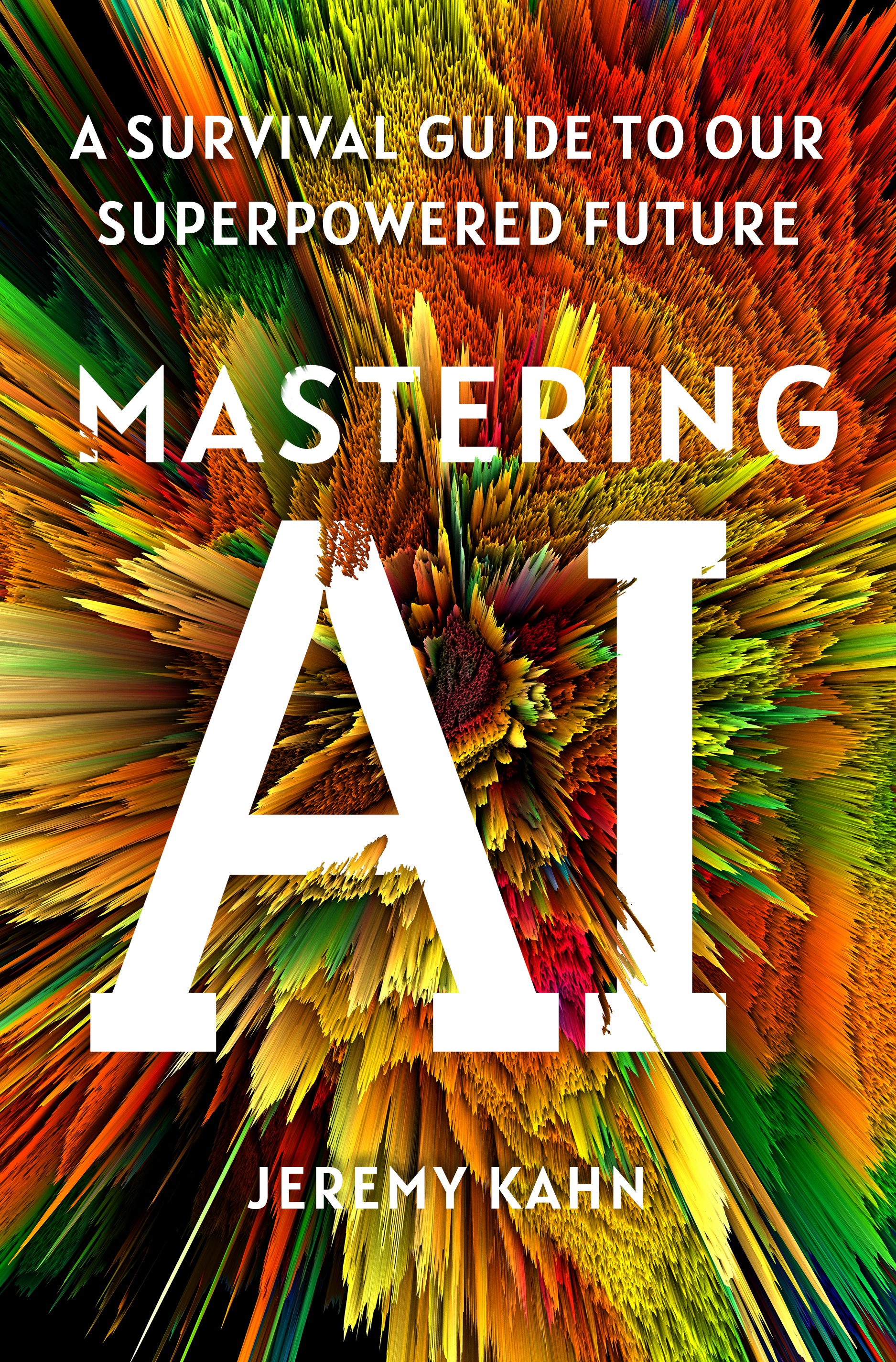
A Survival Guide To Our Superpowered Future

Mastering AI by Jeremy Kahn is absolutely a must-read for every business leader who wants to better understand the history and evolution of AI (Artificial Intelligence), and more important, the promise and perils of AI for businesses and society. Even if you think you have a basic understanding of AI, this book is an essential resource for you. 

That is because Kahn delivers not only a timely, thorough and thought-provoking examination of AI’s benefits to humanity as well as its potentially chilling dangers, but also and vitally, a declaration for how we should proceed as AI evolves.

Reading Mastering AI reminded me of the popular The Popcorn Report by Faith Popcorn – where in 1992 she identified and forecasted trends to chart the future's impact on our businesses, our lives, and our world. 

Similarly, Fortune magazine journalist, Kahn, draws on his expertise and extensive contacts among the companies and scientists at the forefront of artificial intelligence to offer dramatic predictions of AI’s impact over the next decade, from reshaping our economy and the way we work, learn, and create to unknitting our social fabric, jeopardizing our democracy, and fundamentally altering the way we think.

Kahn explains that AI depends on three components:

  1. Algorithms
  2. Computing Power
  3. Data 
What AI does:

  • AI processes massive amounts of data, looking for patterns to model decision-making. 
  • AI enables computers and machines to simulate human intelligence and problem-solving capabilities 
  • AI technology can process substantial amounts of data in ways, unlike humans. 

Within the next five years, Kahn predicts AI will disrupt almost every industry and enterprise, with vastly increased efficiency and productivity. 

For example, Kahn foresees that AI will restructure the workforce, making AI “copilots” necessary for every knowledge worker. 

“Almost every professional, in fields from accounting to medicine to architecture, will be using an AI copilot, helping to automate many routine tasks in their jobs and acting as a kind of digital colleague,” says Kahn. 

And away from work, Kahn forecasts that AI will:

  • Revamp education, meaning children around the world can have personal, portable tutors.
  • Revolutionize health care, making individualized, targeted pharmaceuticals more affordable.
  • Compel us to reimagine how we make art, compose music, and write and publish books. 

“The potential of generative AI to extend our skills, talents, and creativity as humans is undeniably exciting and promising,” shares Kahn. 

However, “while this new technology has a bright future, it also casts a dark and fearful shadow,” warns Kahn. 

Kahn explains that if not carefully designed and vigilantly regulated AI will deepen income inequality, depressing wages while imposing winner-take-all markets across much of the economy. 

Also, continuing a process begun by the internet, AI will rewire our brains, likely inhibiting our ability to think critically, to remember, and even to have a good relationship with one another—unless we all take decisive action to prevent this from happening. 

“Yes, this technology is strange and frightening, but it is also exciting and fabulous in equal measure,” says Kahn. He adds that “like every technology that has come before, we can master AI. But to do so, we must master ourselves. We must apply our own natural intelligence, creativity, and wisdom. If this is indeed the last invention humanity ever creates, we’d better make it good.” 

Jeremy Kahn

Kahn shares these additional insights for business leaders: 

Question: In general, what are the most important factors to consider when thinking about how a company can use AI to gain a competitive advantage? 

Kahn: For most companies, their competitive advantage will come from any proprietary data they have that can give them a competitive edge. 

For large rights holding organizations—such as publishers, movie studios, record labels, pharmaceutical companies, and others with big IP (intellectual property) libraries—this advantage could potentially come from this back catalog of intellectual property. 

But for the majority of companies, the really unique data they have is their own customer data. If they can use that data correctly, AI should allow them to do a better job of market segmentation and then targeting those segments with much more personalized advertising and offers, and possibly, depending on the business, with more personalized products. 

Then the other kind of data that organizations have that might give them a competitive advantage is all the tacit knowledge that is not documented anywhere but exists in the minds and experience of their best performing employees—the people who are true experts and masters of their professional craft (be that sales or operations or legal work). 

Until now, there was no good way to turn that tacit knowledge into data that a company could use. But AI offers a way to potentially capture that tacit knowledge and turn it into data that AI can then process and use to help uplift the performance of workers across the organization. The only big question will be, how best to capture that data so that tacit knowledge can be extracted? The businesses that can figure this out first will have a competitive advantage over others. 

Question: How should a business leader incorporate thoughts of AI into his/her five-year planning? 

Kahn: Leaders need to start thinking now about how AI could potentially reshape the competitive landscape of their industry: 

  • How might it upend existing business models?
  • Are you ready for that shift?
  • How can you defend your business and position it to excel if AI does become the dominant technology platform in the next five years? 

For many leaders, they should begin experimenting with AI now and see what they can do with today's software. But they should also realize that the AI being used today will probably be the worst AI they will use. 

So, they need to project ahead and plan for AI that will be much more capable within five years. For most businesses, this means they should not train their own models but should instead look to buy from outside vendors. They should also try to architect the use of AI in their systems so they are not locked into a particular model or vendor over the long term but could potentially, in a modular way, slot in different models into that architecture. 

What they should definitely do is make sure they have a good handle on all of their data, make sure it is cleaned up, and make sure it is in a form that can easily be accessed by AI to perform useful tasks. That digital transformation is the fundamental foundation on which all else will be built.

___ 

Reading Mastering AI will improve your understanding of the technology (pros and cons), spur your imagination for what is possible, and encourage you to embrace what is necessary to keep AI at bay. 

Kahn is an award-winning journalist for Fortune magazine, where he covers artificial intelligence and other emerging technologies. In addition to cover stories and features, he writes Fortune’s weekly Eye on AI newsletter and cochairs its Brainstorm AI technology conferences. 

Previously, he wrote about technology, including AI, for Bloomberg. His writing on a range of subjects has also appeared in The New York TimesNewsweekThe AtlanticSmithsonian magazine, The Boston GlobeThe New Republic, and Slate

Thank you to the book’s publisher for sending me an advance copy of the book.

Comments

Popular posts from this blog

Best New Leadership Book Of 2025

Each year, after reviewing dozens of books about leadership, management, business and life skills, I select my pick for the best new leadership book of the year. During 2025, I reviewed on this blog 48 books, and I choose  Radical Listening: The Art Of True Connection  as the best new leadership book of 2025. To be an excellent leader you need to be an exceptional listener. Sadly, too many business leaders don't listen well or don't listen to a broad enough range of their employees. This great book will help leaders become better listeners  –  radical listeners. “For leaders, radical listening must start at the top of an organization,” state the authors  Prof. Christian Van Nieuwerburgh (PhD)  and  Dr.   Robert Biswas-Diener .    “Unless there is a clear and sustained commitment to radical listening from leaders, others are less likely to be fully engaged with the idea. This is, of course, easier said than done.”  “Most leaders woul...

The Many Times You Should Thank Customers

In your leadership role, it's vital that your team members know how to deliver excellent customer service. " Knock Your Socks Off " type service as book editor  Ann Thomas  and  Jill Applegate  would say. Part of delivering excellent customer service is saying "Thank You" to your customers and knowing when to say "Thank You". Thomas and Applegate recommend  telling your customers "Thank You" during at least these nine situations : When they do business with you...every time. When they compliment you (or your company) When they offer you comments or suggestions When they try one of your new products or services When they recommend you to a friend When they are patient...and even when they are not so patient When they help you to serve them better When they complain to you When they make you smile You and your team members can say "Thank You" : Verbally In writing  (and don't underestimate the power of  perso...

Paul Smith Teaches You How To Sell With A Story

This is a great week. Because, Thursday, September 8 brings the official release of Paul Smith 's new book, Sell with a Story: How to Capture Attention, Build Trust, and Close the Sale . I'm a big fan of Paul's earlier best-sellers, including Lead with a Story and Parenting with a Story . And, the newest installment in the series is equally good, informative, practical and actionable. Drawing on hundreds of interviews with procurement managers, Paul teaches you how to : Select the right story Craft a compelling and memorable narrative Incorporate challenge, conflict, and resolution Use stories to introduce yourself, build rapport, address objections, add value, bring data to life,  and create a sense of urgency Storytelling definitely works in sales, explains Paul, "because a great story changes everything. It causes buyers to put down their defenses. It helps them relax. It engages their minds and their hearts by appealing to both their intellect and ...

10 Quotes From The 5 Levels Of Leadership -- John C. Maxwell

Soon I'll post my full review of John C. Maxwell's latest book, The 5 Levels of Leadership .  In the meantime, here are some of my favorites quotes from the book that I believe should become a must-read book by any workplace/organizational leader: Good leadership isn't about advancing yourself.  It's about advancing your team. Leaders become great, not because of their power, but because of their ability to empower others. Leadership is action, not position. When people feel liked, cared for, included, valued, and trusted, they begin to work together with their leader and each other. If you have integrity with people, you develop trust.  The more trust you develop, the stronger the relationship becomes.  In times of difficulty, relationships are a shelter.  In times of opportunity, they are a launching pad. Good leaders must embrace both care and candor. People buy into the leader, then the vision. Bringing out the best in a person is often a catal...

How To Maximize Your Chances Of Landing The CEO Role

In the new book, CEO Ready , authors Mark Thompson and Byron Loflin reveal what you need to do to maximize your chances of being the one who secures the top spot. Specifically, they detail the seven key stakeholders  who weigh in on whether to choose you as CEO.   “Collectively, we have coached more than 200 executives who have been selected by their board members to become CEOs,” share the authors. “We can help you prepare to be a great CEO either in your current organization or elsewhere. We will share tools you can use to get objective feedback from all stakeholders, so you have complete visibility into what you’re up against.”   As you seek the CEO role, the authors explain that leadership selection isn't the methodical, objective process that one often imagines. They add that decisions aren't made by robotic executives ticking boxes for attributes such as strategic fit, core competencies, or cultural alignment. Instead, the process is deeply personal, emotional, a...

How to Be a Leader – 9 Principles from Dale Carnegie

Today, I welcome thought-leader Nathan Magnuson as guest blogger... Nathan writes : This is it, your first day in a formal leadership role.   You’ve worked hard as an individual contributor at one or possibly several organizations.   Now management has finally seen fit to promote you into a position as one of their own: a supervisor.   You don’t care if your new team is only one person or ten, you’re just excited that now – finally – you will be in charge! Unfortunately the euphoria is short-lived.   Almost immediately, you are not only overwhelmed with the responsibilities of a team, but you quickly find that your team members are not as experienced or adroit as you.   Some aren’t even as committed.   You find yourself having to repeat yourself, send their work back for corrections, and staying late to fill the gap.   If something doesn’t change soon, you might just run yourself into the ground.   How did something that looked so easy ...

How To Negotiate Disagreement Without Giving Up Or Giving In

  In today’s age of rising division and polarization, disagreement often feels like a zero-sum game.  Unable or unwilling to negotiate conflict with skill, we ignore it or avoid it for as long as possible; when we are forced to face it, we escalate everyday disagreements and temporary flare-ups as if they’re life-and-death. Neither approach addresses underlying issues, promotes stronger relationships, nor yields satisfying results.  It’s no wonder we try to avoid conflict and have a challenging time finding consensus. Conflict is getting the better of us.  But what if conflict could be reframed—not as an obstacle to be overcome but as an opportunity to forge stronger relationships?  In the new book, Conflict Resilience: Negotiating Disagreement Without Giving Up or Giving In , two former Harvard faculty—internationally-recognized negotiator, mediator and conflict management expert Robert Bordone , a Senior Fellow at Harvard Law School, and leading behavi...

How To Tap Into The Wisdom Of People Around You

“Too often, we don’t find out what’s truly on others’ hearts and minds because we don’t know how to  ask  the right questions in the right ways,” explains  Jeff Wetzler , author of the book,  ASK .   In his timely, must-read book, Wetzler shows you a powerful method called  The Ask Approach™ , based on a simple premise: that tapping into what other people truly think, know, and feel is a game-changing superpower for leaders.  Wetzler explains that the only thing that allows you to understand what’s on another person’s mind better is just asking them.   Following the powerful  The Ask Approach™  method will lead you to  smarter decisions, more creative solutions, and deeper relationships. Also, by asking more questions you’ll help break down barriers, resolve challenges, encourage collaboration, and imagine new ways of doing things.   The five practical steps of the research-based, pressure-tested  The Ask Approach™  m...

Leadership Lessons From A Serial Entrepreneur

Brad Jacobs’ new book provides you a treasure trove of leadership lessons from a man with more than four decades of CEO and serial entrepreneur experience. So, even if you don’t envision yourself wanting to earn a billion dollars, don’t pass up reading Jacob’s, How To Make A Few Billion Dollars .   In the book, Jacobs defines the mindset that drives his remarkable success in corporate America  –  and distills a lifetime of business brilliance into a tactical road map. And he shares his techniques for:   Turning a healthy fear of failure to your advantage. Building an outrageously talented team. Catalyzing electric meetings. Transforming a company into a superorganism that beats the competition.   “This book is about what I’ve learned from my blunders, and how you can replicate our successes,” says Jacobs. He shares his candid account of the highs and lows of entrepreneurship.  Jacobs has founded seven billion-dollar or multibillion-dollar businesse...

How To Be More Impactful Through Entrepreneurial Giving

    This Thanksgiving as you think about what you are grateful for, think, too, about how you can be more giving.   To help you discover a more giving you, read the new book, A Talent For Giving , by John Studzinski .   It introduces the meaning of entrepreneurial giving - a hands-on approach to philanthropy that harnesses skills, expertise, and resources. Through thought-provoking insights, A Talent for Giving offers a powerful new roadmap for impact as Studzinski shows how anyone, regardless of financial means, can become a force for change.   You do that by maximizing your Talent , Time , and Treasure and by embracing these values alongside others like Trust , Technology , and Trial , according to Studzinski.   “Giving is any act of kindness or generosity that recognizes and respects the dignity of another human being,” shares Studzinski. “It can be something very simple – a smile, or a hug or a few words. And on a larger scale, it’s giving your time,...