How To Navigate The Ever-Changing Public Relations Landscape

Today brings a book that is an indispensable resource for public relations practitioners who want to learn how to navigate the ever-changing landscape of public relations – which has become a far cry from primarily writing press releases and establishing media contacts. 

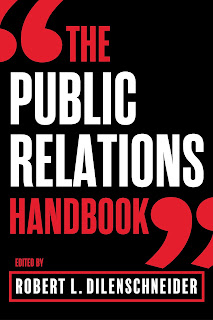
The Public Relations Handbook is the book – the fifth edition of the version that premiered in 1967. This new installment, edited by Robert L. Dilenschneider, teaches readers how to: 

  • Support a company’s marketing and sales
  • Leverage social media
  • Manage government relations
  • Work with the media effectively
  • Communicate with the investment community
  • Support top management in the event of a crisis or scandal
  • Positively position the company commitment to environmental, social and governance issues 

Within the book’s 17 chapters, dozens of leading practitioners address specific skill sets, and execution capabilities that public relations professionals need today. These expert practitioners share their real-life world stories, advice and the actions they took to be successful. 

Read this book if you are a PR professional needing to understand the modern PR world. Understand what is in this book if you are a leader and want to effectively work with the PR professional on your team.

Robert L. Dilenschneider 

Question: How did you select the contributing practitioners/topics/chapters to include in the book? 

Dilenschneider: I chose a successful group of professionals who joined in creating a useful, broad-ranging, up-to-date, and authoritative book. These experts provided me with countless valuable recommendations, and their insights were particularly important in making this handbook reflective of the global nature of modern public relations.  

The world has changed dramatically since the earlier edition was published. It is not only trade that is globalized now, but also communications—and thanks to these contributors, the text reflects that.  

Question: What is the best way for a company leader to use the book? 

Dilenschneider: There are two overriding pieces of guidance in this book: (1) always continue to gather intelligence—assume everything around you is constantly changing—and (2) always recognize how life is being shaped differently, often by men and women whom you do not understand. 

Take seriously the ideas and lessons offered in The Public Relations Handbook. Understanding and following them, and adding the wisdom of your own experience, is crucial to being part of a civilized and organized world.  

Question: How do you predict public relations will continue to evolve over the next ten years? 

Dilenschneider: The need for connections and understanding, at every level of society, has never been greater. I believe that public relations is uniquely positioned to address that need. 

I’m expecting a dramatic growth in the industry. Technology will bring us new ways to communicate in social media circles. 

While Facebook is on the decline, there will be new ways of using existing platforms like LinkedIn. New software will bring additional programs to the forefront. 

Thank you to the book's publisher for sending me a copy of the book.

Comments

Popular posts from this blog

3 Things To Avoid When You Give Your Next Speech

If you don't want to get your speech off to a bad start, the communications experts at Speechworks suggest you: Don't apologize (particularly about your anxiety or lack of preparation. Apologies put your audience on the defensive. Don't start by telling a joke (which may not be all that funny, or is irrelevant, or that may even be offensive to someone in your audience). Don't beat around the bush (including, don't list off a lot of people you want to thank. Don't waste your audience's valuable time) Instead: If you need to deal with your anxiety, practice like crazy . Rehearse particularly your first line over and over. Start your presentation by laying out for your audience a key issue that they are facing in their business . If you must thank someone, do it at the end, or thank your introducer briefly, pause, and then start right into the meat of your message .

High-Performing Teams Are Made Of This

According to Ron Ricci and Carl Wiese, authors of the book,  The Collaboration Imperative , high-performing teams have the following characteristics: People have solid and deep trust in each other and in the team's purpose--they feel free to express feelings and ideas. Everybody is working toward the same goals. Team members are clear on how to work together and how to accomplish tasks. Everyone understands both team and individual performance goals and knows what is expected. Team members actively diffuse tension and friction in a relaxed and informal atmosphere. The team engages in extensive discussion, and everyone gets a chance to contribute--even the introverts. Disagreement is viewed as a good thing and conflicts are managed.  Criticism is constructive and is oriented toward problem solving and removing obstacles. The team makes decisions when there is natural agreement--in the cases where agreement is elusive, a decision is made by the team lead or executiv...

How To Achieve Human Leadership

Human Leadership: The Courage To Face Ourselves And Each Other is Kristen Hadeed ’s newest book. It’s a raw, personal account of losing herself in service to others and the challenging work of finding her way back.   It’s a story of burnout, ambition, resentment, grief, reinvention, profound self-examination, and the courage it takes to share what you discover with the people around you. By learning to face herself, tell the truth, and take ownership of her choices, Hadeed became a more courageous, compassionate leader and built a life and business that would take care of her, too.   Hadeed’s journey shows that leadership doesn’t have to mean endless sacrifice or self-abandonment. Human Leadership offers a different path―one where courage, honesty, and humanity become the foundation of meaningful leadership and a meaningful life.   Part memoir, part invitation, Hadeed’s story will empower you to:   Recognize the values, fears, and limiting beliefs driving your lead...

5 Compelling Benefits Of Having An Ethical Culture

In  Andrew Leigh's  book,  Ethical Leadership , he provides these compelling and important benefits of having an  ethical culture  in your business/organization: Customers prefer dealing with companies who put ethics at the center of their culture. Most employees would prefer to earn less working for an ethical company than being paid more and working for an unethical company. More than one in three people at work say they've left a job because they've disagreed with the company's ethical standards ( Trevino, L and Nelson, K - 2011 ) If you adopt an early warning system against misconduct it reduces the risk of you facing expensive litigation. An ethical culture helps you make your company a strong affirming place to work in. "The foundations of an ethical culture include values, attitudes, meaning, behaviors, purpose, and management practices," explains Leigh.

How To Make One Bold Move A Day

  Shanna A. Hocking ’s new book, One Bold Move A Day , is all about meaningful actions women can take to fulfill their leadership and career potential.   Specially, Hocking reveals the transformative mindsets needed to make one Bold Move a day. Those are: Gratitude Mindset And Mindset Happiness Mindset Progress Mindset   “Each of these four mindsets individually plays a special role in the process of continuously showing up for yourself and others,” explains Hocking. “Each mindset contributes in a different way to your success, but they all complement each other and together they will become the foundation to your Bold Move Mindset.”   Hocking explains in her book that a Bold Move is one that challenges you to grow . “Sometimes it’s about capitalizing on an opportunity, and sometimes it’s about creating that opportunity for yourself,” explains Hocking.   Keep in mind, too, that a Bold Move for you might not be the same as someone else’s.   ...

Coherence: The Secret Science Of Brilliant Leadership

Coherence:  The Secret Science of Brilliant Leadership is the new book by author Dr. Alan Watkins . Trained as a medical doctor, Watkins is now  an honorary senior lecturer in neuroscience and psychological medicine at Imperial College, London and an affiliate professor of leadership at the European School of Management, London. According to Watkins, coherence is the biological state achieved when elite performers experience maximum efficiency and super effectiveness, where body and mind are one . Coherence provides one of the most unique approaches to showing leaders how to be younger, smarter, healthier and happier -- which gives them the power to make decisions under pressure and achieve sustainable success. Prepare to spend quality time reading Coherence . It's not light reading.  Kind of feels like a medical text book in parts.  But, it's worth your commitment to it. I particularly found useful Watkin's discussion on culture , where he w...

Decide

Many years ago, I worked with a person who could not make decisions.  Neither big nor small decisions. That indecisiveness paralyzed our business in many ways. Unfortunately, the book, Decide:  Work Smarter, Reduce Your Stress, and Lead by Example , had not been published.  Had it, I would have shared it with my co-worker. Decide , published this past February, teaches readers how to make better decisions based on the real results they want to experience. The author, Steve McClatchy, explains how to use the two forms of human motivation -- Gain, or Prevent Pain , to make more effective decisions.  For example, he demonstrates how inserting a Gain task in the middle of a Prevent Pain day can give you the energy you need to move forward and make the Prevent Pain tasks take less time through motivation. Deeper into the book, you'll be reminded about not only the problems with procrastination, but also about the benefits of procrastination, and, if you are ...

How To Improve The Way Teams Think, Collaborate And Make Decisions Under Pressure

  “Great decisions don’t happen by accident—they happen by design,” shares Dr. Ricardo Valerdi , author of the new book, The Five-Tool Team: Bringing Out The Best In People To Make Better Decisions .  This book is not about finding perfect answers. It is about building a framework that allows you to make good decisions repeatedly, even when conditions are imperfect, information is incomplete, and outcomes are uncertain.  More specifically, Valerdi reveals a practical framework for improving the way individuals and teams think, collaborate, and make decisions under pressure.   Drawing on lessons from sports, business, engineering, and real-world experience, Valerdi shows how the most effective leaders build teams that question assumptions, analyze consequences, and make choices grounded in clarity rather than instinct or urgency.  “Writing this book has been a phenomenal journey that started in 2018 when I was a visiting professor at the United States Military Ac...

How Will The Value Of Your Days Be Measured?

I recommend that all leaders every so often read the  What Will Matter  poem by  Michael Josephson . It serves as a powerful reminder of the importance of unselfishly serving and leading with character. I've highlighted in bold and in color my favorite parts of the poem: Ready or not, some day it will all come to an end. There will be no more sunrises, no minutes, hours or days. All the things you collected, whether treasured or forgotten, will pass to someone else. Your wealth, fame and temporal power will shrivel to irrelevance. It will not matter what you owned or what you were owed. Your grudges, resentments, frustrations and jealousies will finally disappear. So too, your hopes, ambitions, plans and to-do lists will expire. The wins and losses that once seemed so important will fade away. It won't matter where you came from or what side of the tracks you lived on at the end. It won't matter whether you were beautiful or brillian...

Six-pillar Roadmap For How To Move From Merely Surviving To Truly Mattering

  In the new book, The Mattering Effect: Creating A Life Of Meaning And Worth , podcaster and author John R. Miles reframes today’s most common struggles and empowers individuals and institutions alike to break bad habits and reclaim a sense of worth and belonging. “Organizations have spent the last decade chasing 'engagement' and 'psychological safety,' yet global productivity is stalling and 60% of employees report they do not feel valued in the places where they spend their days,” shares Miles.   He calls this “The Great Erasure”—a condition where high-achievers become highly visible to the organization while becoming invisible to themselves.   In addition, Miles argues that many of today’s most common struggles—burnout, anxiety, loneliness, and disengagement—are not personal failures or mindset problems. They are the result of unmattering: the gradual erosion of felt significance within modern systems that reward performance while overlooking presence.   Fortu...