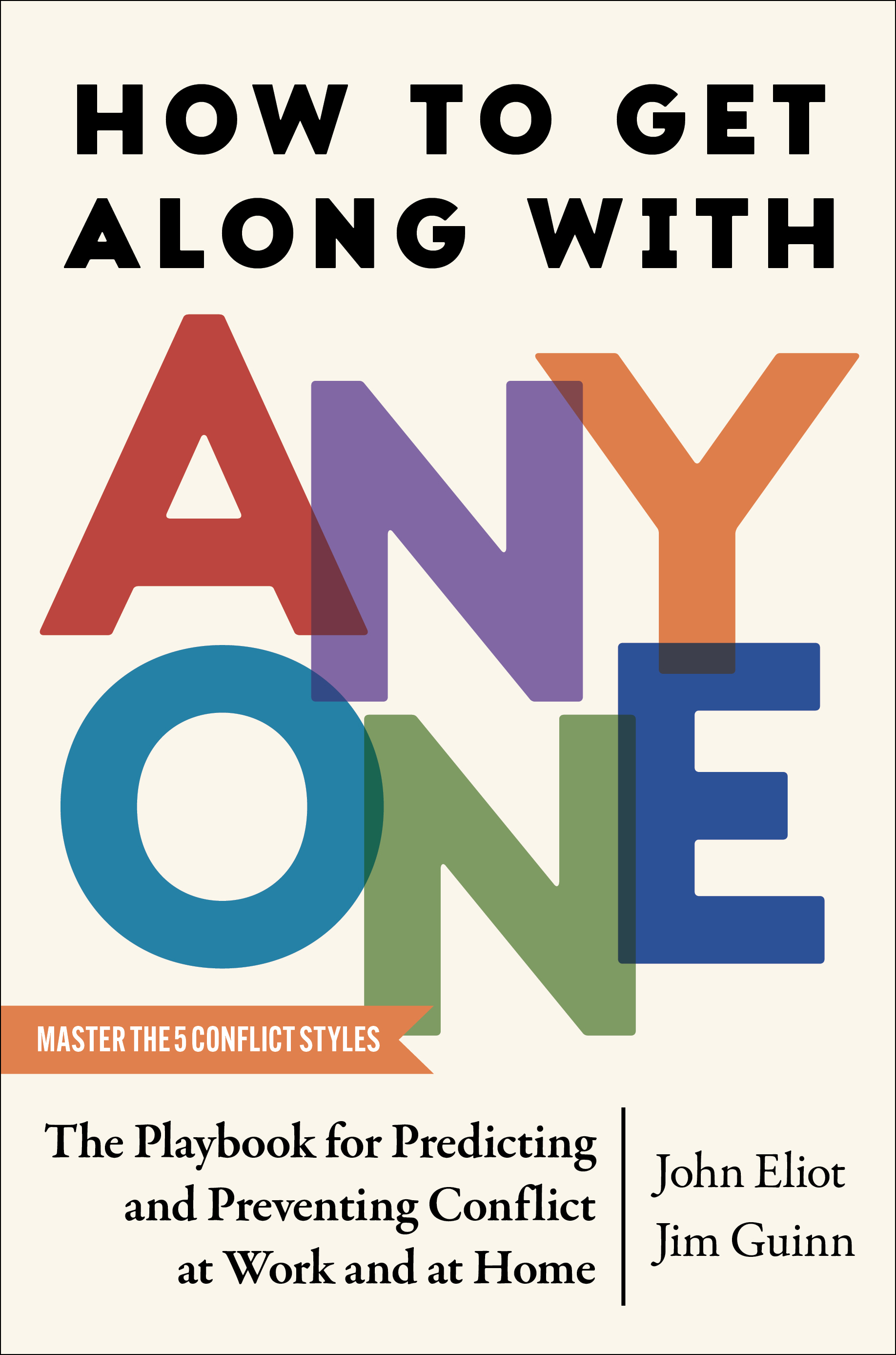
The Playbook For How To Get Along With Anyone

The book, How To Get Along With Anyone, by John Eliot and Jim Guinn, is the playbook for predicting and preventing conflict at work and at home. 

As you read the book, you will discover how to defuse any heated conflict by learning which of the five conflict styles you are and how to resolve even the most sensitive dispute with this must-read guide. 

Through decades of building and facilitating team chemistry for Fortune 500 companies, professional sports franchises, schools and government agencies, nonprofit organizations, and families, Eliot and Guinn have discovered people respond to conflict in one of these five ways: 

  1. Avoider: Uninterested in minor details; excels in solitary work with a knack for concentration. 
  2. Competitor: Always pushing the envelope; never rests on laurel and takes risks for achievement. 
  3. Analyzer: Evidence-based and methodical; patiently gathers information before acting. 
  4. Collaborator: A deeply caring individual, relying on exceptional relationship skills. 
  5. Accommodator: Prioritizes achievements and well-being of those they care about over their own.

“We offer you a pragmatic, hands-on guide to help you determine your own conflict style and identify your coworkers’ and loved ones’ styles. Using this information helps you to foster better communication and more effective collaboration,” the authors add. 

“If you can predict how someone will behave, you can formulate a winning game plan.”  

Why is this so important? Because the average American worker spends 156 hours a year engaged in the kind of moderate to intense workplace conflict that adversely impacts both performance and health. 

And managers spend 26% of their time addressing and resolving conflicts on their team—the equivalent of chewing up one full workday each week. 

"If conflict is left unresolved, workplace conflict leads to shifts in employee attitudes, behaviors, and interactions that spawn ripple effects to the culture and decreased motivation. Productivity declines and so does job satisfaction. Commitment wanes and morale suffers. Absenteeism increases, eventually leading to higher turnover," share the authors.

One of my favorite parts of the book is the section on active listening. The authors remind us that communication exchanges are comprised of three elements, distributed as follows: 

  • 7% - Verbal – What is said, the words themselves. 
  • 38% - Vocal – How something is said, a speaker’s projection, resonance, and tone. 
  • 55% - Visual – The way it’s said, a speaker’s facial expression and body language. 

You can become a better active listener when you do the following according to the authors: 

Be present; Be Centered. When you want to hear someone, full-and want them to know they are being heard—you need to be all in. Temporarily suspend any other concern you have beyond the goal of simply listening. 

Make Eye Contact. When the other person is talking, look them in the eyes. That is the surefire way to establish that you are attending to them. 

Stay Off The Stage. Spend the time entirely centered on what (and how) the other person is sharing. Fight the urge to weave in your opinion, view and so on. 

Be Patient. Wait For It. Remind yourself that there will be ebb and flow; there will be natural pauses. Don’t fill those pauses. Wait. Invite the other person to continue. Employ encouraging body language. Nod, Smile. 

Use Volley Phrases. When waiting for someone to continue doesn’t work, exercise volley phrases, such as, “Tell me more,” “Tell me more about,” “Run that by me again,” Please, go on.” 

Use Reflexive Questioning. This is when you feed someone’s words—and often, more importantly, feelings—back to them, in the form of a question, regarding topics on which you want to move past positions and interests. Make sure to ask these types of questions in a respectful tone, authentically showing that you care. 

Use Open-Ended Questions. And use open-ended probing by using cues that necessitate elaboration. 

Empathize. Put yourself in their footwear. With positive regard. Unconditionally. Use your active listening to decipher where a person is coming from and why. Be accepting. 

Filled with fun, engaging examples and actionable techniques, How to Get Along With Anyone teaches you how to predict and prevent escalated conflict, arming you with practical tools for flipping the script on sticking points to nurture stronger and more meaningful relationships. 

___

John Eliot, PhD, mentors executives and advises professional sports teams, coaches and athletes on how to apply individual and organizational psychology principles for enhancing health, performance, and workplace culture. 

Jim Guinn, EdD, is an assistant professor at Texas A&M University, and director of the Global Youth Sport For Development Initiative, and the Center For Sports Management Research and Education. 

Thank you to the book’s publisher for sending me an advance copy of the book.

Comments

Popular posts from this blog

10 Quotes From The 5 Levels Of Leadership -- John C. Maxwell

Soon I'll post my full review of John C. Maxwell's latest book, The 5 Levels of Leadership .  In the meantime, here are some of my favorites quotes from the book that I believe should become a must-read book by any workplace/organizational leader: Good leadership isn't about advancing yourself.  It's about advancing your team. Leaders become great, not because of their power, but because of their ability to empower others. Leadership is action, not position. When people feel liked, cared for, included, valued, and trusted, they begin to work together with their leader and each other. If you have integrity with people, you develop trust.  The more trust you develop, the stronger the relationship becomes.  In times of difficulty, relationships are a shelter.  In times of opportunity, they are a launching pad. Good leaders must embrace both care and candor. People buy into the leader, then the vision. Bringing out the best in a person is often a catal...

How to Be a Leader – 9 Principles from Dale Carnegie

Today, I welcome thought-leader Nathan Magnuson as guest blogger... Nathan writes : This is it, your first day in a formal leadership role.   You’ve worked hard as an individual contributor at one or possibly several organizations.   Now management has finally seen fit to promote you into a position as one of their own: a supervisor.   You don’t care if your new team is only one person or ten, you’re just excited that now – finally – you will be in charge! Unfortunately the euphoria is short-lived.   Almost immediately, you are not only overwhelmed with the responsibilities of a team, but you quickly find that your team members are not as experienced or adroit as you.   Some aren’t even as committed.   You find yourself having to repeat yourself, send their work back for corrections, and staying late to fill the gap.   If something doesn’t change soon, you might just run yourself into the ground.   How did something that looked so easy ...

How To Harness The Power Of Experiential Intelligence

“Experiential Intelligence provides a new lens from which to view what makes you, you—and what makes your team and organization unique,” says  Soren Kaplan , author of the book,  Experiential Intelligence . Kaplan explains that over 100 years ago, we established IQ (Intelligence Quotient) to predict success. Then we explored Emotional Intelligence (EQ), the theory of multiple intelligences, and mindsets that broaden the definition of smarts.   “Today,  Experiential Intelligence  ( XQ ) expands our understanding of what's needed to thrive in a disruptive world. While you can't change the past, your unique experiences and stories contain hidden strengths and untapped potential for the future,” explains Kaplan.   Experiential Intelligence is the combination of mindsets, abilities, and know-how  gained from your unique life experiences that empowers you to achieve your goals. It allows you to get in touch with the accumulated wisdom and talents you have ga...

70 New Year's Resolutions For Leaders

  With 2026 fast approaching, it's a good time to identify your New Year's Resolutions for next year. To get you started, how about selecting one or more of the following 70 New Year's resolutions for leaders? Perhaps write down five to ten and then between now and January 1, think about which couple you want to work on during 2026. Don't micromanage Don't be a bottleneck Focus on outcomes, not minutiae Build trust with your colleagues before a crisis comes Assess your company's strengths and weaknesses at all times Conduct annual risk reviews Be courageous, quick and fair Talk more about values more than rules Reward how a performance is achieved and not only the performance Constantly challenge your team to do better Celebrate your employees' successes, not your own Err on the side of taking action Communicate clearly and often Be visible Eliminate the cause of a mistake View every problem as an opportunity to grow Summarize group consensus after each deci...

How Ambitious Managers Make The Jump To Leadership

Here’s another must-read book to add to your list as you transition from manager to leader. It’s  The Leap to Leader , by  Adam Bryant . As the creator of the iconic “Corner Office” column in the  New York Times , Bryant has spoken with more than a thousand leaders over the years about the challenges and nuances of leadership. Many of his discussions are included in his interview series on LinkedIn.  “The goal of this book is to provide an intensely practical guide to making that transition by sharing insights, stories, and approaches from hundreds of leaders to build the skills you will need to make the leap to leader,” explains Bryant.   He adds that the book is useful to everyone who is interested in leadership, regardless of where they are in their career.   The book covers:   The central paradox of leaders: selfless vs. self-centered. How to perfect the do-to-say ratio. Ways to navigate office politics. Tactics to making better decisions. The cruc...

Leaders: What Will Matter

I heard the What Will Matter poem yesterday by Michael Josephson and believe it should be read by every leader who wants to unselfishly serve and to lead with character. I've highlighted in bold my favorite parts of the poem: Ready or not, some day it will all come to an end. There will be no more sunrises, no minutes, hours or days. All the things you collected, whether treasured or forgotten, will pass to someone else. Your wealth, fame and temporal power will shrivel to irrelevance. It will not matter what you owned or what you were owed. Your grudges, resentments, frustrations and jealousies will finally disappear. So too, your hopes, ambitions, plans and to-do lists will expire. The wins and losses that once seemed so important will fade away. It won't matter where you came from or what side of the tracks you lived on at the end. It won't matter whether you were beautiful or brilliant. Even your gender and skin color will be irrelevant. So what will...

How To Uncover Your Blindspots To Become A More Effective Leader

What you don't see about yourself can hold you back as a leader. That's typical for many leaders. What we don't see is what we  can't  see: we have  blindspots . Your blindspots prevent you from achieving your greatest success.  “It turns out that we're often not great judges of ourselves, even when we think we are. Sometimes we're simply unaware of a behavior or trait that's causing problems,” explains  Martin Dubin , author of the book,  Blindspotting: How To See What’s Holding You Back As A Leader . “Bottom line: until we uncover these blindspots, we can't move forward. The good news is that you can learn to do your own  blindspotting .”   “Most of us understand the idea of blindspots in a general sense—areas we can’t see, to take the term most literally, or places we have gaps that we may not even realize, to be a little more abstract,” says Dubin.  “But in the context of this book, I’m defining blindspots quite specifically: They are the...

Best New Leadership Book Of 2025

Each year, after reviewing dozens of books about leadership, management, business and life skills, I select my pick for the best new leadership book of the year. During 2025, I reviewed on this blog 48 books, and I choose  Radical Listening: The Art Of True Connection  as the best new leadership book of 2025. To be an excellent leader you need to be an exceptional listener. Sadly, too many business leaders don't listen well or don't listen to a broad enough range of their employees. This great book will help leaders become better listeners  –  radical listeners. “For leaders, radical listening must start at the top of an organization,” state the authors  Prof. Christian Van Nieuwerburgh (PhD)  and  Dr.   Robert Biswas-Diener .    “Unless there is a clear and sustained commitment to radical listening from leaders, others are less likely to be fully engaged with the idea. This is, of course, easier said than done.”  “Most leaders woul...

Leadership Lessons From A Serial Entrepreneur

Brad Jacobs’ new book provides you a treasure trove of leadership lessons from a man with more than four decades of CEO and serial entrepreneur experience. So, even if you don’t envision yourself wanting to earn a billion dollars, don’t pass up reading Jacob’s, How To Make A Few Billion Dollars .   In the book, Jacobs defines the mindset that drives his remarkable success in corporate America  –  and distills a lifetime of business brilliance into a tactical road map. And he shares his techniques for:   Turning a healthy fear of failure to your advantage. Building an outrageously talented team. Catalyzing electric meetings. Transforming a company into a superorganism that beats the competition.   “This book is about what I’ve learned from my blunders, and how you can replicate our successes,” says Jacobs. He shares his candid account of the highs and lows of entrepreneurship.  Jacobs has founded seven billion-dollar or multibillion-dollar businesse...