13 Life Factors That Fuel Your Everyday Success


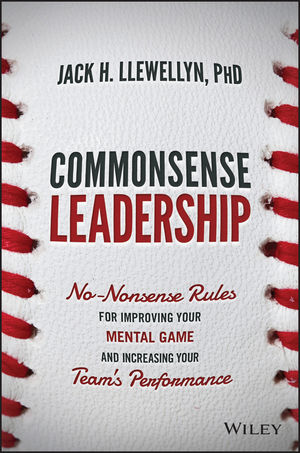
Jack H. Llewellyn, PhD is a sports psychology consultant who has helped a major league baseball pitcher become a Cy Young Award winner, A NASCAR driver go from number six overall to number one and with the Winston Cup Series Championship, and countless leaders at Fortune 500 companies. Now, he’s written the book, Commonsense Leadership: No-Nonsense Rules for Improving Your MentalGame and Increasing Your Team’s Performance.

This is an excellent book for leaders at any stage in their leadership career. It’s a results-driven guidebook that teaches you how to recover quickly from adversity, thrive on stress, preform on the emotional edge, and create a motivating environment (instead of trying to motivate people).

My favorite chapter is the one titled, Winning versus Surviving. In it, Llewellyn outlines the life factors that can fuel your everyday success. Some of those factors include:

No. 1 – Winners expect to win every day. Your plan as a leader should be based on what you expect to gain instead of what you expect to avoid. “The attitude of expecting to achieve something every day puts the probability of success on your side for whatever you may be trying to accomplish,” explains Llewellyn.

No. 2 – Winners have a positive mental attitude. “In practice, this means you may have to back up on occasion and accomplish smaller, separate tasks to regain a positive attitude. Don’t get bogged down by not being able to perform something that is very complex” says Llewellyn.

No. 3 – Leaders play every day at as high an emotional level as they can control.

No. 4 – Leaders strive on stress. Stress can be a wonderful thing if you control the stressors according to Llewellyn. “We make stress negative through our reactions to it,” adds Llewellyn. “The key is to focus your energy, which has traditionally been spent on battling stress, on using stress as an incentive to become better.”

No. 5 – Leaders have specific goals. Winners always know exactly what they want to achieve within a specific time frame.

No. 6 – Leaders realize the importance of teamwork. It’s important that every player know his or her role on the team and be able to execute it.

No. 7 – Leaders communicate with team members, not to team members. Your verbal and nonverbal means of communicating must be used in a very positive and constructive way so that every contact is truly a conversation.

No. 8 – In winning environments, leadership is tolerant of mistakes made while trying to succeed.

No. 9 – Leaders must provide players with a winning environment.

No. 10 – Leaders hold their focus and can change it quickly. No environment—no plan—is perfect, so there must be a plan B.

No. 11 – When focus is lost, winners can recover quickly, and leaders are able to help their team do the same. 

No. 12 – Leaders have balance. Consistent leaders recognize the importance of fulfillment, both personally and professionally, and they evaluate balance in terms of quality, not quantity, or time spent.

No. 13 – Leaders are totally committed to winning; in other words. They have a burning desire to do so.

Comments

Popular posts from this blog

Seven Ways To Stay Motivated

To learn how to stay motivated, read  High-Profit Prospecting , by  Mark Hunter . It's a powerful read that includes counterintuitive advice and cutting-edge best practices for sales prospecting in today's business world. Today, I share one of my favorite sections of the book where Hunter describes his  seven things motivated people do to stay motivated : Motivated people  ignore voices in their lives . These might be people in the office and friends who have bad attitudes. They're out there, and if you're not careful, they'll control you, too. Motivated people  associate with highly motivated people . Just as there are negative people in the world, there are also positive people. Your job is to make sure you spend as much time with the positive people as possible.  Motivated people simply  look for the positive in things . Positive people count it an honor to live each day, learn from others, and impact positively those they meet. Positive people take...

How To Be A More Human Leader

“To be most effective in today’s environment, leaders must be  human  leaders. Human leaders must be able to lead not only with their heads but also with their hearts and souls,” says veteran executive coach  Hortense le Gentil , author of the book,  The Unlocked Leader: Dare to Free Your Own Voice, Lead with Empathy, and Shine Your Light in the World .  She adds, “In addition to being respected, seen, and valued, employees also seek leaders who feel human, not distant and perfect beings with whom they can’t connect.”  Additionally, leaders need to put the collective interest before their own and work hard to make other people’s good ideas happen.  “And although the book focuses on leadership at work, each of us is a complete individual, not a sum of separate, isolated parts. As such, the process presented in the book applies to all areas of your life,” shares the author.  She further explains that becoming a human leader is a journey, not a desti...

29 People Who Taught Us Life Lessons In Courage, Integrity And Leadership

  The 29 profiles you will read in Robert L. Dilenschneider’s new book, Character , are about people who are exceptional exemplars of character. They’re inspirational because they used their abilities at their highest levels to work for causes they believed in. Because of character, they influenced the world for good.   The dictionary defines “character” as the mental and moral qualities distinctive to an individual, the distinctive nature of something, the quality of being individual in an interesting or unusual way, strength and originality in a person’s nature, and a person’s good reputation.   “But beyond these definitions, we know that character is manifested in leadership, innovation, resilience, change, courage, loyalty, breaking barriers, and more,” explains Robert (Bob), “Character drives the best traits in our society, such as honesty, integrity, leadership, and transparency, and it drives others to exhibit those qualities.”   Profiled in the book ar...

Important Questions To Ask Your New Hires

  In  Paul Falcone ’s book,  75 Ways For Managers To Hire, Develop And Keep Great Employees , he recommends asking new employees the following questions 30, 60 and 90 days after they were hired:   30-Day One-on-One Follow-Up Questions Why do you think we selected you as an employee? What do you like about the job and the organization so far? What’s been going well? What are the highlights of your experiences so far? Why? Tell me what you don’t understand about your job and about our organization now that you’ve had a month to roll up your sleeves and get your hands dirty. Have you faced any unforeseen surprises since joining us that you weren’t expecting?   60-Day One-on-One Follow-Up Questions Do you have enough, too much or too little time to do your work? Do you have access to the appropriate tools and resources? Do you feel you have been sufficiently trained in all aspects of your job to perform at a high level? How do you see your job relating to the organi...

Leading Business Transformation That Lasts

David Shaner's compelling,  The Seven Arts of Change , shows business leaders that transforming a business only happens when each employee equates organizational change with the process of deep personal growth. "The bottom line is that, despite how technological and automated organizations have become, at their core they remain a collection of human energies that are merely being applied in an organized environment," explains Shaner.  "Resurrecting and guiding that human core of your organization is the secret to leading and sustaining change," he adds. Shaner pulls from his vast professional and personal experiences, including having been a member of the Olympic Valley USA Ski Team and a former Harvard University teacher, to lay out a seven-part "spiritual guide" for change: The Art of Preparation (Assessment) The Art of Compassion (Participation) The Art of Responsibility (Accountability) The Art of Relaxation (Clarity, Focus, Visibility)...

Chick-fil-A Serves Up 11 Leaders On May 6

On May 6 , the quick-service chicken restaurant chain, Chick-fil-A will serve up more than chicken.  Because, that's the day when the chain's President and COO Dan Cathy brings together 10 influential leaders during a one-day leadership " Leadercast " available at hundreds of locations around the U.S. and overseas. "We desire to influence leaders at every level within an organziation. Whether you are leading a team of 2,000 or just yourself, the Chick-fil-A Leadercast is designed to help you use your voice to create positive change," explains the organization. I am a big fan of Chick-fil-A because of its customer service.  It is also known as a company that has built its success on core values and its focus on developing leaders .  I also like that employees respond with "my pleasure" instead of "no problem" when customers say "thank you." Chick-fil-A says leaders can express themselves with five voices (described below i...

Why Your Middle Managers Are So Important

The book,  Power To The Middle , shows how  managers  are the crucial link between a company’s ground floor and top brass. “Too often company leaders view middle managers in a negative light as expendable employees who can slow down productivity and overall strategy,” explain the book’s authors and McKinsey partners  Bill Schaninger ,  Bryan Hancock , and  Emily Field .  “However, new KcKinsey research reveals that this outdated perspective needs to change and that well-developed managers  are  the strategy that companies must prioritize to succeed today,” they add.  Most importantly, by the end of their book, the authors sum up their insights and provide a  playbook  that will help senior leaders let go of the command-and-control mindset that has hobbled their managers for so long.  The authors define middle managers as the people who are at least once removed from the front line and at least a layer below the senior lead...

Looking Back: Best New Leadership Book Of 2016

Flashback to 2016... After reading nearly 30 new books about leadership this past year, my pick for  2016's best new leadership book  is,  Mastering the Challenges of Leading Change , by  H. James Dallas . Technically, the book came out in the fall of 2015, but gained its popularity and momentum in 2016, hence my selection as my 2016 pick. Virtually every business is undergoing change. And, one of the most difficult things for a leader to do is to successfully lead a change initiative. And, change is what most employees fear most. That's why, says Brown that on average nearly 75 percent of change initiatives fail. What's more... When the rate of external change exceeds the rate of internal change, the end is in sight. Fortunately, Brown has written what I consider to be one of the most straight-forward, practical and timely books on how to lead a transition through change effectively. H. James Dallas More specifically, Brown covers much more than tasks, timing and te...

How to Be a Leader – 9 Principles from Dale Carnegie

Today, I welcome thought-leader Nathan Magnuson as guest blogger... Nathan writes : This is it, your first day in a formal leadership role.   You’ve worked hard as an individual contributor at one or possibly several organizations.   Now management has finally seen fit to promote you into a position as one of their own: a supervisor.   You don’t care if your new team is only one person or ten, you’re just excited that now – finally – you will be in charge! Unfortunately the euphoria is short-lived.   Almost immediately, you are not only overwhelmed with the responsibilities of a team, but you quickly find that your team members are not as experienced or adroit as you.   Some aren’t even as committed.   You find yourself having to repeat yourself, send their work back for corrections, and staying late to fill the gap.   If something doesn’t change soon, you might just run yourself into the ground.   How did something that looked so easy ...

Full Engagement By Brian Tracy

Best-selling author Brian Tracy's book, Full Engagement , provides practical advice for how to inspire your employees to perform at their absolute best. He explains that above nearly every measure, employees' most powerful single motivator is the "desire to be happy." So, Tracy teaches you how to make your employees happy by: Organizing their work from the first step in the hiring process through the final step in their departure from your company so they are happy with you, their work, their coworkers, as well as in their interactions with your customers, suppliers and vendors. Full Engagement includes these chapters and topics: The Psychology of Motivation Ignite the Flame of Personal Performance Make People Feel Important Drive Out Fear Create That Winning Feeling Select The Right People Internal Versus External Motivation At a minimum, Tracy suggests that managers do the following when managing their employees : Smile Ask questions Listen ...