How To Use The CPR Business Efficiency Framework To Eliminate A Team's Pain Points

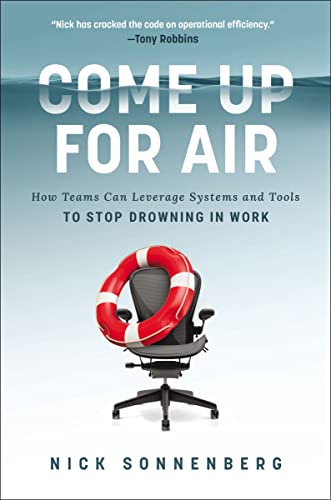
In Nick Sonnenberg’s book, Come Up For Airyou’ll learn about his CPR Business Efficiency Framework, which stands for: 

  • Communication
  • Planning
  • Resources 

This framework focuses on eliminating the pain points most teams experience by optimizing these three operation areas foundational to every organization.

“In my book, I show you the tools that will boost efficiency in all three of these domains and I provide you with a detailed blueprint for the most effective ways to use them,” explains Sonnenberg.

He further shares that some sections of the book may be more applicable to managers, and some may be more applicable to individual contributors. “However, it is still integral that both roles understand all of the concepts within the CPR Framework as each one benefits the team as a whole,” says Sonnenberg.

As you read the book, you’ll learn what Sonnenberg has learned through years of building a leading efficiency consulting business – that the primary reason why so many teams are overwhelmed is not because they don’t have enough time, or that managers expect too much of their employees, or that there aren’t enough people. The problem is that everyone is drowning in unnecessary work and inefficiencies that prevent them from focusing on the work that drives results.

Sonnenberg believes that by implementing the CPR Framework, you and your team will:

  • Reduce stress and burnout by creating a more stable work environment.
  • Eliminate the 58% of employee time per day spent on “work about work” instead of being productive.
  • Improve company culture by empowering your team to spend their time on work that matters.
  • Stop wasting time on the “Scavenger Hunt” of trying to find where information is stored.
  • Increase employee happiness, satisfaction, trust, and retention by making work easier.
  • Stop wasting time in meetings with four proven techniques.

Additionally, supplementing the teachings found within the book, Sonnenberg provides you with more learning opportunities via free content and in-depth instructions at ComeUpForAir.


Nick Sonnenberg

Play special attention to the Three Key Takeaways and Pro Tips that expertly summary each respective chapter's teachings. 

Earlier this year, Sonnenberg shared these insights with us:

Question: How long does it typically take for an organization/company to fully embrace and fully benefit from the CPR Framework?

Sonnenberg: It depends on so many factors, such as:

  • how big is the team?
  • how tech savvy?
  • how willing to adopt change?
  • how bought in is the leadership in the transformation?
  • what tools is the team using already?

On average, however, it takes about a month per tool IF you invest the time to learning and show up.

Question: You say that even a team using the best systems and tools on the market can still be inefficient and drown and in work. What’s the missing link there?

Sonnenberg: The missing link is that teams aren’t aligned on when and how to use each tool in the same way. One person likes email, another likes Slack, someone else keeps track of everything in a spreadsheet, etc.

When everyone is using different tools in different ways, information starts to live in different places, and it makes work needlessly confusing. It becomes difficult to get everyone on the same page. So, a huge part of the solution is simply aligning as a team on when to use which tools, and then establishing some baseline knowledge around how to use them efficiently.

Question: What do you mean when you say that by using your CPR method that people can potentially free up a whole workday of productivity?

Sonnenberg: The reality is that there are thousands of inefficiencies in most businesses, and almost everyone is struggling with the same things. We’re all wasting time in meetings, searching for information, chasing people for status updates, endlessly checking email, getting distracted by notifications. The CPR Framework focuses on tools that most companies are already using, and it can quickly fix a lot of those common inefficiencies.

We find that, on average, we’re able to save people at least five, but more like eight hours per week just by optimizing when and how they use their tools as a team. And that’s time that people can either reinvest into the business, or if they’re underwater, it means they can go home at a normal hour, and they don’t have to keep playing “catch up” or working on the weekends.

Question: How do you define productivity?

Sonnenberg: There’s a famous quote from Peter Drucker that says, “Efficiency is doing the thing right. Effectiveness is doing the right thing.” To me, productivity is when you’re being both efficient and effective with your time.

Question: Any favorite personal hacks you yourself like to use?

Sonnenberg: Loom is a fantastic tool I use almost every day. It lets you create a recording of your screen and webcam with just one button, and when you’re done it converts the video to a link so you can instantly share it with anyone. It saves me tons of time, especially running a remote company.

Question: With all the systems and tools on the market, how do you even begin to select the right tools for you and your team?

Sonnenberg: Well, you’ll be happy to hear that the actual software you choose doesn’t really matter. What really matters is understanding which types of tools to use, and when and how to use them.

For example, Slack and Microsoft Teams are both “internal communication tools.” They effectively do the same thing, and they have mostly the same features. It doesn’t really matter whether you’re on Slack or Microsoft Teams—they’re both going to get the job done. What matters is that you and your team are aligned on when and how to use that tool in conjunction with your other tools. And the same could be said for work management tools, knowledge base tools, etc.

Question: You say individual productivity is necessary but not sufficient for team productivity. What can co-workers do right now to get more on the same page?

Sonnenberg: I think the biggest thing is to optimize for the speed of retrieval of information. What this means is that when you have a document, message, file, update—whatever it may be—you should really stop and think for a second about where the best place to put it is. Because chances are, someone in the future is going to need to find that thing.

It might be easier for you to just put it in an email or call someone to let them know. But that’s how things get lost, and you could be making your coworkers’ lives a lot harder in the future. So just take a step back and spend the extra few minutes to put things in the right place, where they won’t get lost, and you can save your entire team a ton of time in the future.

Thank you to the book's publisher for sending me an advance copy of the book.

Comments

Popular posts from this blog

Let's Meet At The Intersection Of Marketing, Leadership And Blogging! A Q&A With Debbie Laskey

  Credit: iStock Photo For the past 16 years, I have relied on Debbie Laskey's Blog for expert leadership guidance and always interesting insights into marketing best practices and recaps of marketing trends.  Fortunately, through the years, Debbie has also shared her expertise through a variety of postings on my blog, and I'm honored again today to feature Debbie with the following Q&A's:  QUESTION: You've featured many leadership experts on your blog through the years. What is a common theme from all the Q&A's? DEBBIE LASKEY : Back in 2011, I met Mark Herbert, a leadership expert and author based in Oregon, as a result of our interactions on Twitter/X. I interviewed him several times, and he provided a quote that I will always remember and share often: "Leadership doesn't require you to be the smartest person in the room. It requires you to block and tackle for others." That quote has appeared on my blog countless times over the years because...

How To Reclaim Your Time And Be Time Smart

“Four out of five adults report feeling that they have too much to do and not enough time to do it,” reports  Ashley Whillans , author of the book,  Time Smart: How to Reclaim Your Time and Live a Happier Life . “These time-poor people experience less joy each day. They laugh less. They are less healthy and less productive.” And, in one study, time stress produced a stronger negative effect on happiness than unemployment.   Drawing on the latest science, Whillans teaches us how to escape the time traps that make us feel this way and keep us from living our best lives.   She explains that the  six most common time traps  are: Constant connection to technology. Obsession with work and making money. Limited value placed on time. Busyness as a status symbol. Aversion to idleness. The Yes…and then regret it effect.   Her playbook shows you how to :   take back the time you lose to mindless tasks and unfulfilling chores. improve your "time affluence.” f...

The Algorithm: The Five-Step Framework That Drives Business Success

    From a former President of Tesla, Jon McNeill , comes The Algorithm —the first book written by any of Elon Musk’s direct reports—a transformative guide for leaders, entrepreneurs, and innovators who want to emulate the paradigm-shattering approach used to launch Tesla and SpaceX to success.  And that transformed Lululemon and General Motors. McNeill had already founded and sold six startups when Sheryl Sandberg introduced him to Elon Musk, who was looking for help at Tesla. McNeill was steeped in the lean principles that had made Toyota a global powerhouse—principles focused on achieving efficiency and optimization by incrementally improving existing systems and processes. What he learned at Tesla was an approach that required radical rethinking to explode the status quo, attack complexity, and set seemingly unrealistic goals. Elon Musk at Tesla called this five-step framework “The Algorithm.”   1. Question every requirement – “Question everything—from produ...

10 Quotes From The 5 Levels Of Leadership -- John C. Maxwell

Soon I'll post my full review of John C. Maxwell's latest book, The 5 Levels of Leadership .  In the meantime, here are some of my favorites quotes from the book that I believe should become a must-read book by any workplace/organizational leader: Good leadership isn't about advancing yourself.  It's about advancing your team. Leaders become great, not because of their power, but because of their ability to empower others. Leadership is action, not position. When people feel liked, cared for, included, valued, and trusted, they begin to work together with their leader and each other. If you have integrity with people, you develop trust.  The more trust you develop, the stronger the relationship becomes.  In times of difficulty, relationships are a shelter.  In times of opportunity, they are a launching pad. Good leaders must embrace both care and candor. People buy into the leader, then the vision. Bringing out the best in a person is often a catal...

How To Achieve Real Optimism Even When Life Is Hard

  “Optimism is not about believing that everything will turn out the way you want it; that everything will go according to plan, or that positive thinking about the future can stave off disaster. It’s about accepting that life is hard—sometimes really hard—but it always has something to teach us,” explains Dr. Deepika Chopra , author of the new book, The Power Of Real Optimism: A Practical, Science Based Guide To Staying Resilient, Curious, And Open Even When Lie Is Hard . She adds, “If we can stay open to those lessons, we will survive.”  Why should we strive to become more optimistic? “Because, simply put, optimism improves our mental and physical health and makes us more able to face whatever life has in store while staying committed to our goals and values,” shares Dr. Chopra.  In this fresh, science-backed debut, professional psychologist and media expert Dr. Chopra shows us how to build the kind of optimism that can actually withstand real life. The book offe...

How To Change Yourself To Change Your Company

The book,   Reinventing the Leader ,  is an inspiring account of the magic that can happen when a leader realizes they must undergo their own transformation in order to transform their organization.  This candid and practical book by  Guilherme  ( Gui) Loureiro , Regional CEO overseeing Walmex, Walmart Canada, and Walmart Chile (now Chairman of the Board for Walmex and Regional CEO for Canada, Chile, Central America, and Mexico), and his executive leadership coach  Carlos Marin  shows how even the most successful leaders must be open to personal change in order to transform their company. The book details how the pair pioneered a data-driven, customer-centric business transformation at Walmex—Walmart’s biggest division outside of the United States. “This book is a blueprint for transformational success for leaders in any business who find themselves facing the need to retool their own company’s systems and operations and energize and inspire an entire ...

How To Be A Servant Leader

Check out the  definitive book on servant leadership . It's a curated collection of incredibly insightful and motivational perspectives on servant leadership via essays by 44 servant leaders. Edited by  Ken Blanchard  and  Renee Broadwell ,  Servant Leadership in Action , includes the personal stories from some of the most well-respected authorities on leadership: Patrick Lencioni John C. Maxwell Marshall Goldsmith Stephen M. R. Covey Plus, you'll read keen advice from celebrated sports coaches, company CEO's, pastors and retired military leaders. Each of the  44 stories/chapters  stands strong on its own. However, Blanchard and Broadwell group them within  six parts : Fundamentals of Servant Leadership Elements of Servant Leadership Lessons in Servant Leadership Examples of Servant Leadership Putting Servant Leadership to Work Servant Leadership Turnarounds Get your pen or highlighter ready. You're sure to take lots of notes as you capture advice...

How To Create More Human Workplaces By Tackling Hidden Patterns

Most organizational change initiatives fail because they treat symptoms, not systems. Real transformation happens when you see and redesign the hidden patterns driving how work actually works.  “Hidden Patterns prioritize principles over procedures. Each pattern is a tested, fundamental idea, not a formula,” explains Clay Parker Jones , author of the new book, Hidden Patterns, A Playbook For More Human Workplaces . Based on behavioral science and real-world case studies, the book identifies 75 common organizational problems , the core solutions to each, and connected patterns to link sustainable improvements.   “If the examples or templates don’t seem immediately relevant, that’s fine,” shares Jones. “The core principle is what matters. Take the idea, apply it flexibly, and test it out. Make it your own.”  “In the book, you’ll find patterns that lay groundwork for healthier, more humane workplaces rather than prescriptive tactics masquerading as guaranteed quick fixes.” J...

The 12 Ways Marriott Practices Good Leadership And Customer Service

The next time you stay at a Marriott hotel look in the nightstand drawer for Marriott's booklet that highlights its milestones and tells the Marriott story. In the booklet, you'll find the following 12 ways that Marriott practices good leadership AND customer service : Continually challenge your team to do better. Take good care of your employees, and they'll take good care of your customers, and the customers will come back. Celebrate your people's success, not your own. Know what you're good at and mine those competencies for all you're worth. Do it and do it now. Err on the side of taking action. Communicate. Listen to your customers, associates and competitors. See and be seen. Get out of your office, walk around, make yourself visible and accessible. Success is in the details. It's more important to hire people with the right qualities than with specific experience. Customer needs may vary, but their bias for quality never does. Elimin...

Five Essential Principles For Sustaining Growth Through Innovation

Even though many companies strive for innovation, most struggle to achieve meaningful change. The largest reason for this disconnect? Playing it safe. Leaders and organizations want to implement new ideas, but too often they are held back by the fear of failure, even though setbacks are intrinsic to the innovation process. In the new book, No Fear, No Failure , by Lorraine H. Marchand (with John Hanc), readers will learn how to overcome the status quo that stifles creative thinking and how to create a culture that encourages innovation. Marchand provides a framework for sustained growth built on the “ 5 Cs ”:   Customer First Culture Collaboration Change Chance   She draws on more than 120 interviews with leaders across industries, real-world case studies, and her firsthand experience and shares step-by-step, field-tested strategies, tactics, and tools that practitioners can use to embed creativity within organizational cultures. Marchand is a former Big Tech and Big Pharma ex...