
"Stress is on the rise, both at work and home, and we cannot avoid it," says Jenny C. Evans. "The problem is that trying to 'reduce' stress is simply a waste of time. Instead, people need to become 'resilient' to stress, learning how to quickly recover from it," explains Evans.
Evans teaches readers of her new book, THE RESILIENCY rEVOLUTION: Your Stress Solution For Life 60 Seconds at a Time, how to become resilient to stress.
Evans is also founder and CEO of PowerHouse Performance, where she works with thousands of C-suite executives, leaders, and employees worldwide to help them improve their resilience, performance and productivity, while enhancing their health.

Jenny C. Evans
Her new book is fully of stories, action plans and techniques for becoming healthier (eating healthfully, exercising, etc.) to create the resiliency you need to combat stress.
This week, Evans shared these additional insights about what she teaches in her book:
Question: All too often someone with good intentions can't make it all the way through the four-week period, and fails to transform a new behavior into an automatic habit. What is the best advice for making it all the way to the end of the fourth week?
Evans: Most
of us kick off a change strategy relying on self-discipline and willpower to
start practicing different behaviors. The problem is that willpower is a very
limited resource, and it’s easily exhausted. Research shows the more we use it,
the less of it we have. This explains why many of us start strong with a new
behavior, then find it almost impossible to maintain it over the long term.
An
easier and more successful strategy is incorporate optimal defaults into your
plan for change. An optimal default is a small tweak to your environment that
makes change automatic. You actually have to go out of your way to make a choice that’s not in alignment with your
goals.
Let’s
say you’re trying to eat less food. Instead of using your limited supply of willpower,
here are some optimal defaults you can use that will trick your brain into
automatically eating less – without you knowing it and without the stress that
comes with dieting.
- Switch to smaller plates, bowls, and serving utensils. When we use smaller dinnerware, we unconsciously eat less.
- Use taller, thinner glasses for drinking. We will unknowingly pour 30% more liquid into a short, wide glass.
- Keep serving dishes in the kitchen instead of dining family style. Leaving them in another room results in us eating approximately 20% less food.
- Keep tempting foods out of sight or at a distance. Instead of having a candy dish on the corner of your desk at work, move it to a filing cabinet away from your desk. You’ll eat about 77% more when you can see it and easily reach it.
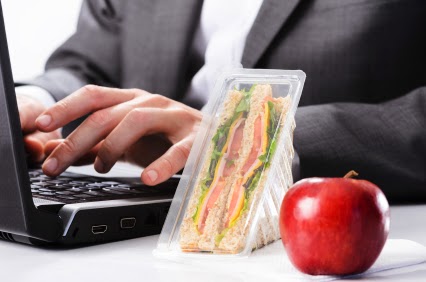
Question: Traveling
for business often derails a person's healthy eating habits, exercise routine,
and sleep routine. What's the best advice to make business travel as
least disruptive?
Evans: It can add an extra layer of challenge, but traveling doesn’t have to be the deal breaker we often make it out to be. From a diet perspective, approach travel with a different mindset: you didn’t have to do the shopping, food prep, clean up, and the chef can make you what you want, how you want it. If you’re ordering room service or at a restaurant, Plate It Out. Don’t even open the menu:
- Decide what you want your lean protein to be and how you want it cooked.
- Next, find out what your options for fruit and/or vegetable are and how you’d like them prepared.
- Lastly, order some sort of grain, ideally one that is less processed. I’m on the road myself 4-6 times a month and I’ve never had my requests like these turned down.
Another
essential strategy is to stock your briefcase or car with healthy, low glycemic
snacks like nuts and seeds, whole grain crackers, trail mix, nutrition bars and
dried fruit. This ensures you’ll always have the right foods available at the
right time.

When
it comes to exercise, if you’ve got your body and gravity is turned on, you’re
good to go! Your body makes a great piece of cardiovascular and resistance
training equipment. Things like squats, push-ups, tricep dips, lunges, burpees,
jumping jacks, shadow boxing and jumping rope (without a rope) get your heart
rate up and challenge your muscles. All
with no equipment and no gym. You can do all of these things in the privacy of
your hotel room without much space.
This
style of exercise is also great from a time and resources perspective. You’re
combining your cardiovascular and resistance training together, so it’s a
shorter workout. Doing each exercise listed above for 30-60 seconds makes a
great interval-training workout, which is a more efficient and effective way of
increasing your fitness. It also burns more fat and calories.

Exercising
regularly helps us fall asleep more quickly, sleep more soundly, and increases energy,
so there are many positive side effects from squeezing in exercise. It’s also
important to try and keep to your sleep/wake schedule as much as possible.
Bring the strategies that help you sleep well at home with you on the road. For
example, we don’t have a TV at our house. When I first started traveling I
would lie in the hotel bed at night and binge watch (so many channels!).
Unfortunately, it was too stimulating and different from my usual sleep
routine, and would keep me awake. At home I listen to a podcast to help me fall
asleep and I do the same thing when I travel.
It’s
also critical to watch how much caffeine and alcohol we consume. It can be easy
to use these as tools to help us get through jet lag or get our energy up or
down, but they’ve got several negative side effects. First, caffeine has a long
half-life and can increase our wakefulness long after drinking it. Second,
alcohol can help us fall asleep more quickly, but it will also disrupt our sleep
later on in our sleep cycles. Lastly, too much caffeine and alcohol stimulate
the stress response, and the last thing we need to do is add to the stress of
travel.
Question: Tell me
more about PowerHouse Hit the Deck and the benefits of purchasing it.
Evans: I designed PowerHouse Hit the Deck as a tool to help people build their resiliency to stress: to recover from it more quickly and efficiently, as well as to raise their threshold for it. It’s a quick, convenient, easy tool you can use any time, anywhere, and it’s great for people who are busy or travel. It’s also an effective tool for increasing fitness, muscle mass, energy, sleep and health, while reducing body fat and stress.

PowerHouse Hit the Deck consists of thirty-five
cards along with a programmable interval timer. Each card features one exercise
activity that uses your own body weight – no equipment necessary. The goal is
to draw a card and do as many repetitions as possible of that exercise during
the time set on the timer— ideally thirty to sixty seconds. The designated
exercise will both elevate your heart rate as well as challenge your muscles:
the very same actions as the fight-or-flight response. These short bursts train your body to recover
from stress more quickly and efficiently. They also raise your threshold for
it.
If you have time for only one card, that’s fine. The short
burst will use the stress hormones for the purpose they were designed to serve,
and you get a release of hormones that restore balance and neutralize the
negative effects of stress. If you’ve got time for more, then stop the timer,
draw another card, and turn the timer back on when you’re ready to go. Do as
many repetitions as possible of that exercise until the timer beeps. Do a
series of cards if you can. The recurring intervals will train your body to
recover from stress as quickly as possible, and continuing to push yourself
raises your threshold for stress.
You’re also getting an effective cardiovascular
and resistance-training workout in the process. All with no equipment!
Question: If you can
commit to only one new behavior -- eating healthy or exercising, which one do
you believe is most important and why?
Evans: It
really depends on what your goals are! If you’re looking for a better way to
deal with the stress in your life, to sleep better at night, improve your
fitness, or increase muscle tone or strength, then exercise is the way to go.
If you want to lose weight, research shows that healthy eating makes more of an
impact initially, but adding exercise
to the mix helps keep the weight off long term.

If you start incorporating some optimal defaults, you’re not
left to choosing only one new behavior to focus your limited self-discipline
on. I mentioned some nutrition optimal defaults earlier, and here are some for
getting more exercise: Join a social group that’s centered around exercise.
Sleep in your exercise clothes, wake up and work out. Turn off the TV – you’ll
move more and skip the junk and fast food advertising. Keep a spare set of
workout clothes in your car or office. Take your workout gear to work so you
don’t have to stop at home first (and get sucked in to staying). Get a workout
partner.

Question: Explain
what you mean by perceived stress.
Evans: Our perceptions of stress can vary quite widely. Stress can be real or imagined. We’re quite skilled at projecting into the future and coming up with possible scenarios that could happen, or rehashing things from our past. It can be psychological or physiological. The mental stress of a looming deadline is different than the stress placed on your muscles from lifting something heavy or having to sprint to catch your flight. Stress can also be positive or negative. A job promotion, marriage or birth of a child is typically interpreted as a positive life event, but can and does induce stress. In addition, what one person perceives as stress can be an exciting experience to another and vice versa. Public speaking is considered to be at the top of the list of most people’s fears, but it’s something I love to do.
We
also all interpret the world through our own lenses. Our past experiences,
personality traits and physiological states determine whether we perceive
something to be stressful or not. If you’ve never traveled out of the country
you may find a trip to Europe quite stressful. But for someone who’s traveled
widely, going to Europe would be an easy, low-stress event. If you’re sleep
deprived or ravenously hungry, your stress response will be more easily
triggered than when you’re well rested and fed.
Comments
Post a Comment