
Author Branham On Trust, Exit Interviews And Why Employees Leave

Over the past year, 1,000 people who left an employer told author Leigh Branham the reasons for why they left.
 
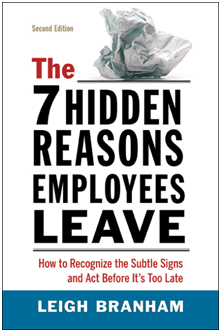
Those reasons, captured in a post-exit survey, contribute greatly to the new release of the second edition of Branham's best-seller, The 7 Hidden Reasons Employees Leave.


The original edition was based on feedback from nearly 20,000 surveys. 
 
The updated book includes insights regarding some additional new survey questions, such as:
  • Was there a triggering event?
  • How long did it take until you actually left?
  • What could your employer have done to make you want to change your mind and stay?
  • Did you look for another job while still employed.
Eye-opening highlights from the book reveal that:
  • The cost of losing the average employee is one times their annual salary.  That means that  company with three hundred employees, an average employee salary of $35,000, and a voluntary turnover rate of 15 a year is losing $1,575,000 per year in turnover costs alone.
  • Employee turnover is not a single event; it is really a process of disengagement that can take days, weeks, months, or even years.
In the book, Branham teaches readers how to:
  • Avoid employee-job mismatches.
  • Build an environment of mutual trust and confidence.
  • Understand the emotional impact of compensation and recognition done well.
  • Leverage exit and turnover data (often from exit interviews) to increase employee retention.
 

Last week, Branham spoke to me about:
  • Trust in senior leaders
  • Exit interviews
  • The impact of e-mail and texting on employee turnover
  • What surprised him the most about the answers to the 1,000 post-exit surveys
Question:   Where would you put the current trust in senior leaders?  Is it at the lowest it's been since you've been in the business world?

Branham:   I would have to say yes, unfortunately.  When I entered the business world in the 70's, we assumed leaders were competent and trustworthy.  Even in the 80's and early '90's, they were good stewards and heroes--Lee Iacocca, Jack Welch, et. al.  But things changed during the boom years and greed took over for many.

Then came Enron, Worldcom in 2002, then the crash of 2008 exposed the depth of corruption.  It was a devastating double whammy that had the effect of disappointing everyone in the workforce while, paradoxically, causing the issue of senior leadership to start showing up on their radar as more of a factor with regard to how much discretionary effort they were willing to give (engagement). 

The consulting and survey firms, Towers Watson and Kenexa came to the same conclusion as Mark Hirschfeld and I did in our book, Re-Engage, based on our analysis of 2.1 million engagement surveys--trust in the integrity, competence, and compassion of senior leaders is now the number one factor in employee engagement, in spite of the fact that the conventional wisdom says it's all about the manager. 

Yes, it's all about the manager, but it's the senior leaders who set the tone and culture and the example for managers to follow.  Yet, the most commonly used employee survey in the world today--Gallup's 12 questions, contains not one question about senior leadership.
 
QuestionIf a business can't hire/use a third-party to do the exit interviews, how best should they be done to elicit the most candid feedback from the exiting employee?
 
Branham:  First, I would say they should explore finding a way to afford it if that's the issue because the outcomes are almost always superior. That's because some employees simply will not tell any company representative the real reason they are leaving no matter how trustworthy they may seem. 

But if paying a third-party is not in the cards, they should find the most trusted person in HR to conduct the interviews, make sure they know the data collected is important, then train them in the finer points of conducting an exit interview, especially with regard to follow-up questions.  For more on this, see my appendix in The 7 Hidden Reasons  Employees Leave on exit interviewing.


Question:  When reading the 1,000 post-exit surveys that inspired the updated edition, what in those surprised you the most?

Branham:  I think the biggest surprise was how closely the new data resembled the data from Saratoga, despite the changes in the economy since the first edition came out in 2005, especially that the seven-reason themes were the same and that nine of out 10 primary reasons for leaving were push factors instead of pull factors, again exactly the same as Saratoga's data showed.
 
In fact, of the 39 possible reasons for people to choose from on our web survey (www.keepingthepeople.com), none of the 11 "pull" reasons ranked higher than number 23 on the list.

I expected senior leadership to be a major factor, but didn't expect it to be the number one reason. I didn't necessarily expect "insufficient pay" to be the number two reason, but when I consider the pay freezes and small annual pay increases that have been widespread in recent years, it's understandable.
 
Question:  How has the increased use of e-mail either helped or hindered employee turnover versus a time when employees engaged in more in-person and phone engagement compared to e-mail exchanges? 
 
Branham:  I do think e-mail and texting have depersonalized manager-employee interaction, as has the increasing trend toward the remote workforce. 

Many younger workers have admitted to actually ignoring voice messages entirely and don't return them.  I'm not saying we shouldn't use e-mail and texting.  I'm saying we should use all communications media at our disposal to:
  • check in with direct reports
  • ask how they are doing, what they need
  • ask for their ideas and really listen and take action on the good ones
  • make sure they know what's expected
  • give frequent feedback
In other words, they should manage the way the best sports coaches coach.  Face-to-face is best, but when face-to-face is not always possible, the phone is next best, then e-mail, then texting when it's urgent 
One of the consistent reasons employees leave is they have managers who don't communicate in any of these ways.  In fact, I've seen research that 60 percent of employees don't get enough feedback and that only one in five employee accomplishments is acknowledged by managers. 

Thanks to the book publisher for sending me an advance copy of this book.

Comments

Popular posts from this blog

Let's Meet At The Intersection Of Marketing, Leadership And Blogging! A Q&A With Debbie Laskey

  Credit: iStock Photo For the past 16 years, I have relied on Debbie Laskey's Blog for expert leadership guidance and always interesting insights into marketing best practices and recaps of marketing trends.  Fortunately, through the years, Debbie has also shared her expertise through a variety of postings on my blog, and I'm honored again today to feature Debbie with the following Q&A's:  QUESTION: You've featured many leadership experts on your blog through the years. What is a common theme from all the Q&A's? DEBBIE LASKEY : Back in 2011, I met Mark Herbert, a leadership expert and author based in Oregon, as a result of our interactions on Twitter/X. I interviewed him several times, and he provided a quote that I will always remember and share often: "Leadership doesn't require you to be the smartest person in the room. It requires you to block and tackle for others." That quote has appeared on my blog countless times over the years because...

How To Reclaim Your Time And Be Time Smart

“Four out of five adults report feeling that they have too much to do and not enough time to do it,” reports  Ashley Whillans , author of the book,  Time Smart: How to Reclaim Your Time and Live a Happier Life . “These time-poor people experience less joy each day. They laugh less. They are less healthy and less productive.” And, in one study, time stress produced a stronger negative effect on happiness than unemployment.   Drawing on the latest science, Whillans teaches us how to escape the time traps that make us feel this way and keep us from living our best lives.   She explains that the  six most common time traps  are: Constant connection to technology. Obsession with work and making money. Limited value placed on time. Busyness as a status symbol. Aversion to idleness. The Yes…and then regret it effect.   Her playbook shows you how to :   take back the time you lose to mindless tasks and unfulfilling chores. improve your "time affluence.” f...

The Algorithm: The Five-Step Framework That Drives Business Success

    From a former President of Tesla, Jon McNeill , comes The Algorithm —the first book written by any of Elon Musk’s direct reports—a transformative guide for leaders, entrepreneurs, and innovators who want to emulate the paradigm-shattering approach used to launch Tesla and SpaceX to success.  And that transformed Lululemon and General Motors. McNeill had already founded and sold six startups when Sheryl Sandberg introduced him to Elon Musk, who was looking for help at Tesla. McNeill was steeped in the lean principles that had made Toyota a global powerhouse—principles focused on achieving efficiency and optimization by incrementally improving existing systems and processes. What he learned at Tesla was an approach that required radical rethinking to explode the status quo, attack complexity, and set seemingly unrealistic goals. Elon Musk at Tesla called this five-step framework “The Algorithm.”   1. Question every requirement – “Question everything—from produ...

10 Quotes From The 5 Levels Of Leadership -- John C. Maxwell

Soon I'll post my full review of John C. Maxwell's latest book, The 5 Levels of Leadership .  In the meantime, here are some of my favorites quotes from the book that I believe should become a must-read book by any workplace/organizational leader: Good leadership isn't about advancing yourself.  It's about advancing your team. Leaders become great, not because of their power, but because of their ability to empower others. Leadership is action, not position. When people feel liked, cared for, included, valued, and trusted, they begin to work together with their leader and each other. If you have integrity with people, you develop trust.  The more trust you develop, the stronger the relationship becomes.  In times of difficulty, relationships are a shelter.  In times of opportunity, they are a launching pad. Good leaders must embrace both care and candor. People buy into the leader, then the vision. Bringing out the best in a person is often a catal...

How To Achieve Real Optimism Even When Life Is Hard

  “Optimism is not about believing that everything will turn out the way you want it; that everything will go according to plan, or that positive thinking about the future can stave off disaster. It’s about accepting that life is hard—sometimes really hard—but it always has something to teach us,” explains Dr. Deepika Chopra , author of the new book, The Power Of Real Optimism: A Practical, Science Based Guide To Staying Resilient, Curious, And Open Even When Lie Is Hard . She adds, “If we can stay open to those lessons, we will survive.”  Why should we strive to become more optimistic? “Because, simply put, optimism improves our mental and physical health and makes us more able to face whatever life has in store while staying committed to our goals and values,” shares Dr. Chopra.  In this fresh, science-backed debut, professional psychologist and media expert Dr. Chopra shows us how to build the kind of optimism that can actually withstand real life. The book offe...

How To Change Yourself To Change Your Company

The book,   Reinventing the Leader ,  is an inspiring account of the magic that can happen when a leader realizes they must undergo their own transformation in order to transform their organization.  This candid and practical book by  Guilherme  ( Gui) Loureiro , Regional CEO overseeing Walmex, Walmart Canada, and Walmart Chile (now Chairman of the Board for Walmex and Regional CEO for Canada, Chile, Central America, and Mexico), and his executive leadership coach  Carlos Marin  shows how even the most successful leaders must be open to personal change in order to transform their company. The book details how the pair pioneered a data-driven, customer-centric business transformation at Walmex—Walmart’s biggest division outside of the United States. “This book is a blueprint for transformational success for leaders in any business who find themselves facing the need to retool their own company’s systems and operations and energize and inspire an entire ...

How To Be A Servant Leader

Check out the  definitive book on servant leadership . It's a curated collection of incredibly insightful and motivational perspectives on servant leadership via essays by 44 servant leaders. Edited by  Ken Blanchard  and  Renee Broadwell ,  Servant Leadership in Action , includes the personal stories from some of the most well-respected authorities on leadership: Patrick Lencioni John C. Maxwell Marshall Goldsmith Stephen M. R. Covey Plus, you'll read keen advice from celebrated sports coaches, company CEO's, pastors and retired military leaders. Each of the  44 stories/chapters  stands strong on its own. However, Blanchard and Broadwell group them within  six parts : Fundamentals of Servant Leadership Elements of Servant Leadership Lessons in Servant Leadership Examples of Servant Leadership Putting Servant Leadership to Work Servant Leadership Turnarounds Get your pen or highlighter ready. You're sure to take lots of notes as you capture advice...

How To Create More Human Workplaces By Tackling Hidden Patterns

Most organizational change initiatives fail because they treat symptoms, not systems. Real transformation happens when you see and redesign the hidden patterns driving how work actually works.  “Hidden Patterns prioritize principles over procedures. Each pattern is a tested, fundamental idea, not a formula,” explains Clay Parker Jones , author of the new book, Hidden Patterns, A Playbook For More Human Workplaces . Based on behavioral science and real-world case studies, the book identifies 75 common organizational problems , the core solutions to each, and connected patterns to link sustainable improvements.   “If the examples or templates don’t seem immediately relevant, that’s fine,” shares Jones. “The core principle is what matters. Take the idea, apply it flexibly, and test it out. Make it your own.”  “In the book, you’ll find patterns that lay groundwork for healthier, more humane workplaces rather than prescriptive tactics masquerading as guaranteed quick fixes.” J...

The 12 Ways Marriott Practices Good Leadership And Customer Service

The next time you stay at a Marriott hotel look in the nightstand drawer for Marriott's booklet that highlights its milestones and tells the Marriott story. In the booklet, you'll find the following 12 ways that Marriott practices good leadership AND customer service : Continually challenge your team to do better. Take good care of your employees, and they'll take good care of your customers, and the customers will come back. Celebrate your people's success, not your own. Know what you're good at and mine those competencies for all you're worth. Do it and do it now. Err on the side of taking action. Communicate. Listen to your customers, associates and competitors. See and be seen. Get out of your office, walk around, make yourself visible and accessible. Success is in the details. It's more important to hire people with the right qualities than with specific experience. Customer needs may vary, but their bias for quality never does. Elimin...

Five Essential Principles For Sustaining Growth Through Innovation

Even though many companies strive for innovation, most struggle to achieve meaningful change. The largest reason for this disconnect? Playing it safe. Leaders and organizations want to implement new ideas, but too often they are held back by the fear of failure, even though setbacks are intrinsic to the innovation process. In the new book, No Fear, No Failure , by Lorraine H. Marchand (with John Hanc), readers will learn how to overcome the status quo that stifles creative thinking and how to create a culture that encourages innovation. Marchand provides a framework for sustained growth built on the “ 5 Cs ”:   Customer First Culture Collaboration Change Chance   She draws on more than 120 interviews with leaders across industries, real-world case studies, and her firsthand experience and shares step-by-step, field-tested strategies, tactics, and tools that practitioners can use to embed creativity within organizational cultures. Marchand is a former Big Tech and Big Pharma ex...